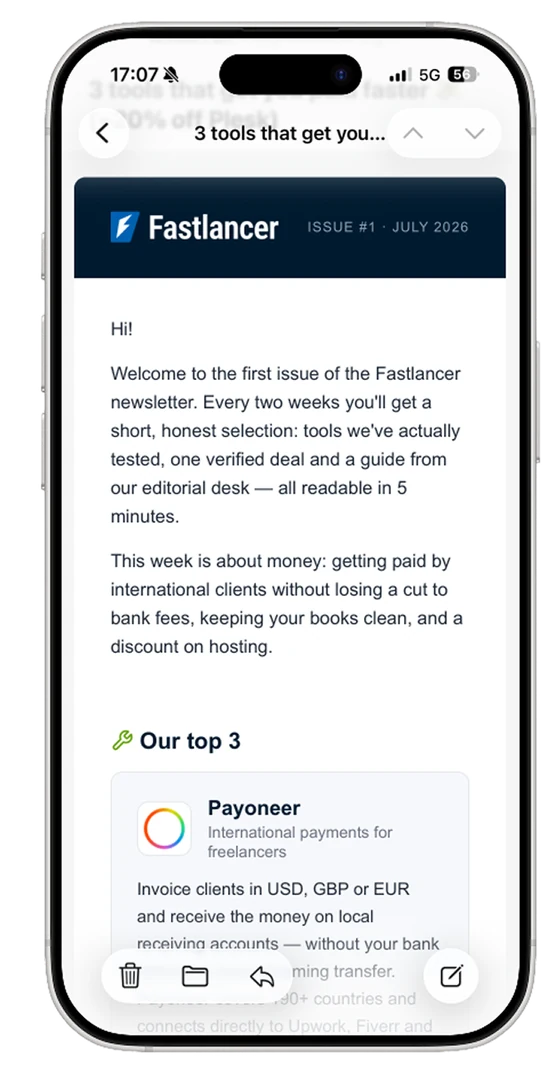
bunq Review 2026: The Neobank Business Account, Tested
Fastlancer Team · Updated: Aug 11, 2026
Short verdict
Ideal for
- Freelancers who want taxes and reserves automatically split across sub-accounts
- Digital-first independents who prefer app banking with virtual cards over branches
- Founders who want to start on a free account and upgrade when needed
- Sustainability-minded freelancers (tree-planting program, green investments)
Not ideal for
- Anyone who needs to deposit cash or visit a branch
- Limited companies — the free account is for sole traders
- People who expect phone support
- Entry price
- Free plan · paid from €799 / month
- Free to start?
- Yes — Free Business account at €0 forever, paid plans with a 30-day free trial
- Stands out for
- Sub-accounts with their own IBAN (up to 25 on Pro/Elite) plus a choice of local IBANs — tax reserves and budgets separate themselves almost automatically
What is bunq?
bunq is a Dutch neobank with a full banking license — not an e-money institution, but a real bank with deposit protection up to €100,000. The business account targets freelancers and small businesses who want to run everything from an app: open the account in minutes, create cards digitally, no branch and no paper.
The main reason it stands out is a feature almost nobody else builds this consistently: the sub-account architecture.
The USP: sub-accounts with their own IBAN
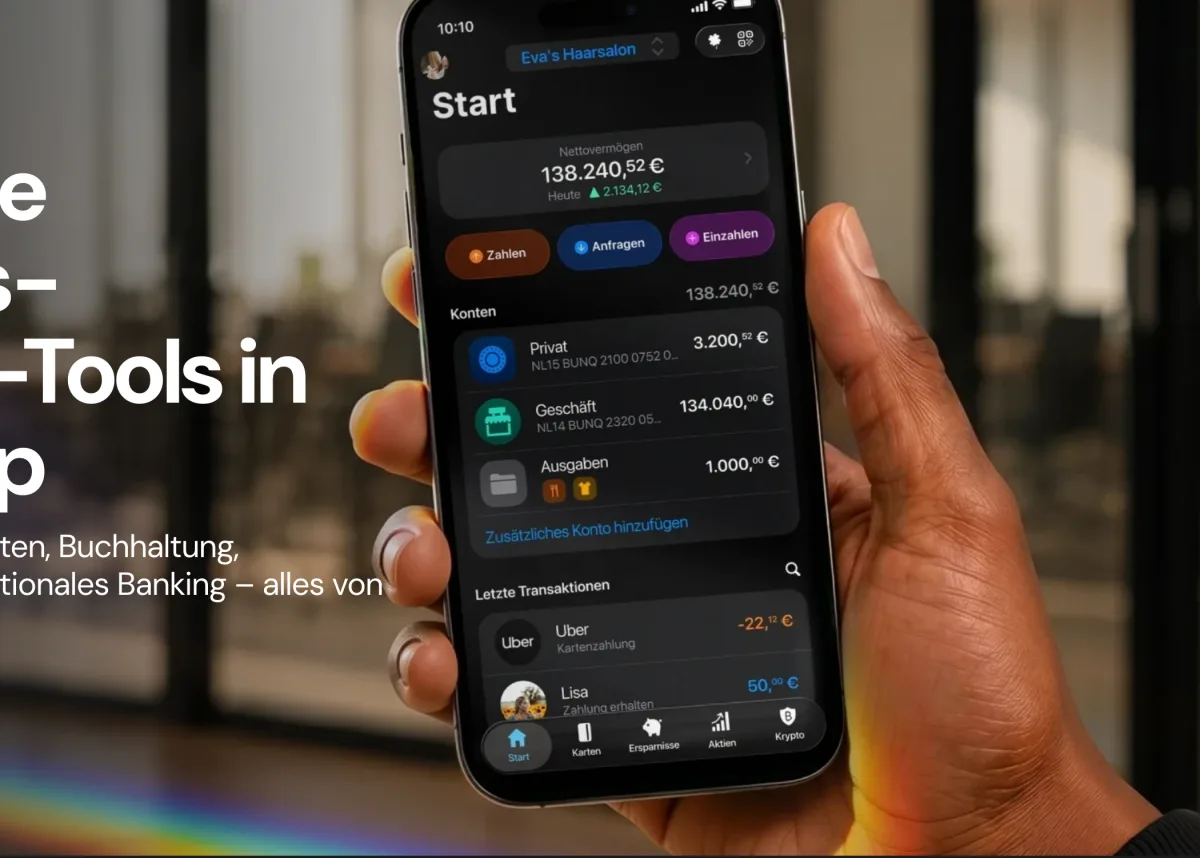
Depending on the plan you create 3 (Free), 5 (Core) or up to 25 sub-accounts (Pro/Elite) — each with its own IBAN. That sounds unspectacular but transforms your financial hygiene: one sub-account for VAT, one for the income tax reserve, one per major project, one for the emergency fund. The Payment Sorter splits incoming payments automatically by percentage or amount rules — the tax reserve happens on the side instead of never. Add virtual cards you create in seconds and assign to specific purposes (tool subscriptions, ad budgets), plus budgeting and savings tools in the app.

Sustainability and extras
bunq positions itself as a green bank: tree-planting program, CO₂ tracking and sustainable investment policies. How much that matters is personal — measurably, it is part of the brand. More practical day to day: multi-currency features and interest on balances (conditions change regularly — check current terms before opening).
Pricing: from free to Elite
The free account is for sole traders only and carries a limited number of sub-accounts — and those are precisely why people choose bunq. The full sub-account architecture arrives on the two upper tiers. Anyone who wants tax, reserves and running costs cleanly separated should budget for a paid plan.
Above that, the tiers differ in cards, foreign spending and interest. Cash deposits are not possible, and support runs through the app and chat only.
IBAN choice: the old NL problem is solved
For years the Dutch IBAN was bunq's biggest catch for German customers — some providers rejected direct debits from non-DE IBANs. That is history: bunq now offers local IBANs from five countries (DE, NL, FR, ES, IE), and German business customers can get a German IBAN. Cash deposits work too these days — via retail partners (viacash/Barzahlen), with the first €100 per month free and 2.5% beyond that. For automatic tax features, still compare with the local specialists.
Who is bunq worth it for?
bunq suits independents who actively structure their finances and prefer app banking: the sub-account discipline is a real productivity gain, and the free tier makes trying it risk-free for sole proprietors. If you move a lot of cash, want phone support, or just need a simple account without architecture ambitions, you'll be served cheaper and simpler elsewhere.
What we like about bunq and what we don't
Pros
- Sub-accounts with own IBAN, auto-split payments
- Free Business account forever
- Virtual cards created in seconds
- Real bank, €100,000 deposit protection
- Sustainability program with tree planting
Cons
- Full 25 sub-accounts need Pro/Elite plan
- Support only via app or chat
- Free tier limited to sole proprietors
Pricing
Free Business
Free
free forever — for sole proprietors
- Fully functional business account with IBAN
- 3 sub-accounts
- Pay-per-use extras
Core
€7.99
per month
- 5 sub-accounts with their own IBAN
- Mastercard debit included
- Budgeting and savings tools
Pro / Elite
€13.99 / €23.99
per month
- Up to 25 sub-accounts with their own IBAN
- 3 physical + 25 virtual cards
- 6 free cash withdrawals/month
Prices may change — check the official website for current plans.
Alternatives by use case
- Finom If a local IBAN without a monthly fee is the main need
- Vivid Money If cashback on card spend comes first
- Tide If the business is registered in the UK



Frequently Asked Questions
How much does the bunq business account cost?
Four tiers, with the free account limited to sole traders. The boundary is not price but sub-accounts: the full architecture people come to bunq for only arrives on the two upper tiers. Cash deposits are not possible, and support runs through the app and chat.
Do I get a local IBAN with bunq?
Yes — bunq now offers a choice of local IBANs from five countries (DE, NL, FR, ES, IE); German business customers can get a German IBAN. The old NL-IBAN friction with German direct debits is off the table. Whether the local IBAN is available on the free tier is best checked during signup.
Is my money safe with bunq?
Yes — bunq is a fully licensed Dutch bank, and balances are protected up to €100,000 per person under the Dutch deposit guarantee scheme.
What do bunq's sub-accounts do for freelancers?
That is bunq's strongest feature: up to 25 sub-accounts, each with its own IBAN. Tax reserves, VAT, an emergency fund and project budgets stay cleanly separated — incoming payments can be split automatically by rule. Hardly any other business account at this price does it this granularly.
bunq or a local fintech — which fits freelancers better?
Local specialists like Kontist (Germany) offer deep automatic tax integration for solo freelancers. bunq counters with more account flexibility (sub-accounts with own IBANs, virtual cards, multi-currency, a choice of local IBANs) and a free entry tier. Rule of thumb: automatic tax integration = local fintech; maximum account architecture = bunq.
Verdict
bunq is the most flexible business account in our comparison: the sub-account architecture with individual IBANs is unbeatable for disciplined reserve-keeping, the now-available choice of local IBANs (including German) removes the old main objection, and the free tier makes entry risk-free for sole proprietors. The full power only unlocks on Pro/Elite — if you just want a simple account, you'd pay for architecture you don't use. For automatic tax integration, Kontist remains the specialist.