Zoho Books Review 2026: Accounting with a Real Free Plan, Tested
Fastlancer Team · Updated: Sep 4, 2026
Short verdict
Ideal for
- Freelancers and small businesses under $50K revenue starting on the free plan
- Solopreneurs invoicing internationally: multi-currency, client portal, online payments
- Users of other Zoho products (CRM, One) who want accounting to plug right in
- Small teams that want projects, time tracking and inventory in their accounting tool
Not ideal for
- Businesses past the free plan's revenue cap that want a gentle price step
- Anyone whose accountant expects QuickBooks or Xero files
- German freelancers needing ELSTER or DATEV
- Entry price
- Free plan · paid from $15 / month
- Free to start?
- Yes — 14 days free, no credit card; plus a free-forever plan for small businesses
- Stands out for
- Full double-entry accounting with a free-forever plan under $50K revenue, client portal and deep Zoho ecosystem integration — one of the best value plays in small-business accounting
What is Zoho Books?
Zoho Books is the accounting product of Zoho's 50+ app business suite — full double-entry accounting covering quotes, invoices, expenses, bank reconciliation, inventory, projects with time tracking and reporting. It's localised for dozens of countries, with tax handling to match, and plugs natively into Zoho CRM, Inventory and the rest of the ecosystem.
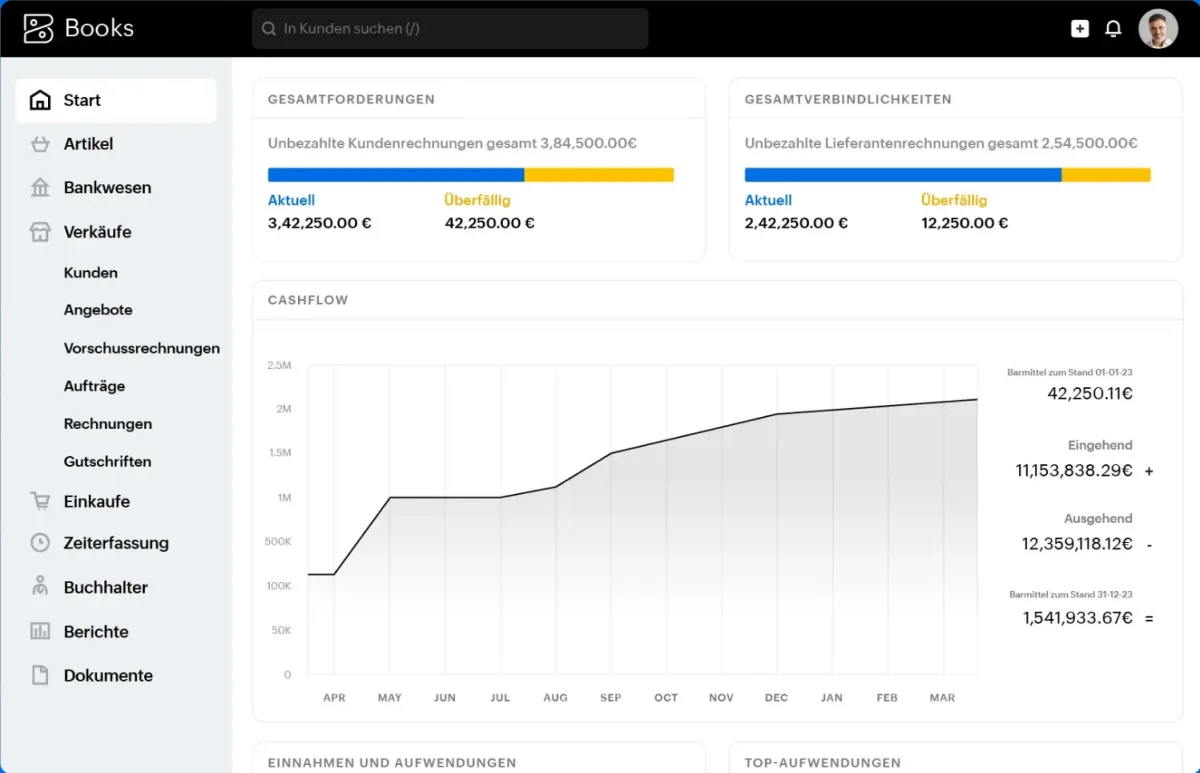
The headline is the free-forever plan: not a trial, but a real offer for businesses under $50K annual revenue — including features most competitors charge for.
The free plan: remarkably complete
Free includes up to 1,000 invoices a year, bank reconciliation, an accountant seat, a client portal and online payments (sales-tax tracking starts on Standard). A bootstrapping freelancer can run their entire billing on it. Paid tiers add users, quotes and purchasing (Standard/Professional), automation and forecasting (Premium), up to store connectors for Shopify, Amazon and eBay (Elite) and advanced analytics (Ultimate) — all priced per organisation, not per user.
Value: where Zoho Books beats the big names
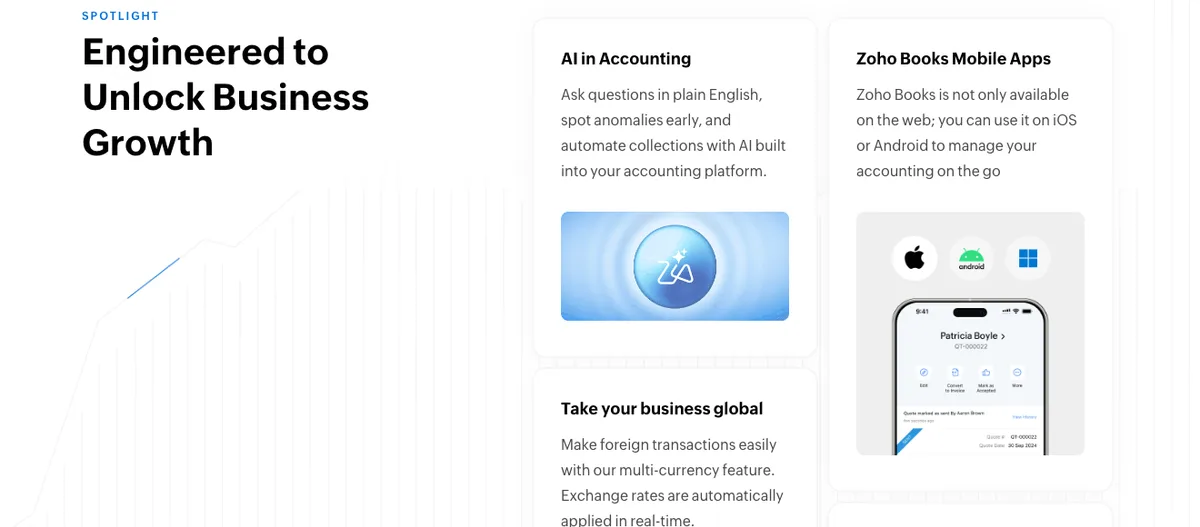
At $15/month (yearly) for Standard, Zoho Books undercuts QuickBooks' entry plan by more than half — while including things the competition sells separately: projects and time tracking (billable hours flow straight into invoices), inventory, recurring invoices and payment reminders. Reviews rate it 4.4/5 on Capterra across 670 reviews; the recurring criticism is support quality, not the product. For European clients, EU e-invoicing formats via the Peppol network are covered too.
Zoho Books vs. QuickBooks and Xero
The honest comparison: QuickBooks owns US accountant mindshare — if your CPA dictates the tool, that's often the end of the debate. Xero leads in the UK, Australia and New Zealand with unmatched bank coverage — see our Xero review. Zoho Books wins whenever you choose for yourself on value: more included per dollar, a real free plan, and the ecosystem effect if Zoho CRM or Zoho One is already in play.
Who is Zoho Books worth it for?
Freelancers and small businesses that watch costs and want accounting, projects and inventory in one place — and especially anyone already using Zoho products. If your accountant runs your books and lives in QuickBooks, follow your accountant; everyone else should at least start the free plan and see how far it carries. More options in our accounting tools overview.
What we like about Zoho Books and what we don't
Pros
- Genuine free-forever plan with bank reconciliation
- Standard plan undercuts Xero and QuickBooks
- Projects, time tracking and inventory built in
- Deep Zoho ecosystem integration
- Solid ratings on Capterra and G2
Cons
- Free plan capped at $50K revenue
- Support quality draws recurring criticism
- Less accountant mindshare than QuickBooks/Xero
Pricing
Free
Free
free forever while revenue stays under $50K/year
- 1 user + 1 accountant
- 1,000 invoices/year, bank reconciliation
- Client portal and online payments
Standard / Professional
$20 / $50
per month · $15/$40 billed yearly
- 3–5 users, 5,000–10,000 invoices/year
- Quotes, purchase orders, multi-currency (Pro)
- Projects, time tracking, inventory (Pro)
Premium / Elite / Ultimate
$70 / $150 / $275
per month · $60/$120/$240 billed yearly
- 10–15 users, up to 100,000 invoices
- Workflow automation, custom modules
- Budgets, cashflow forecasts, fixed assets
Prices may change — check the official website for current plans.
Alternatives by use case
- Xero If the accountant expects a regional standard
- Norman If the business files in Germany and needs free e-invoices
- Accountable If German income tax should go out from the same tool
Frequently Asked Questions
How much does Zoho Books cost?
A free-forever plan for small revenue, then four paid tiers with annual billing cheaper than monthly. The free plan is capped by revenue rather than features, and that cap is the usual reason to upgrade. Watch the step above it: the jump from free to the first paid tier is the steepest in the ladder.
Is Zoho Books really free?
Yes — the free plan is permanent, not a trial, for businesses with annual revenue under $50K. It includes 1,000 invoices per year, bank reconciliation, a client portal, online payments and one accountant seat. For a bootstrapping freelancer, that's remarkably complete — most competitors gate reconciliation behind paid plans.
Zoho Books or QuickBooks/Xero — which is better?
Zoho Books wins on price (free plan, $15 entry vs. $38 at QuickBooks Simple Start) and on built-in breadth — projects, time tracking and inventory come included. QuickBooks wins on US accountant mindshare and payroll depth; Xero on UK/NZ/AU bank coverage and its app marketplace. If your accountant has no preference and you watch costs, Zoho Books is the value pick.
Does Zoho Books handle multi-currency and international clients?
Yes, from the Professional plan: invoices in your client's currency with automatic exchange-rate handling, plus a client portal where customers view and pay invoices online. E-invoicing standards for various countries (including EU formats via the Peppol network) are supported — useful if you bill European clients.
What are Zoho Books' limits for growing businesses?
Each plan caps users and invoice volume (e.g. Standard: 3 users, 5,000 invoices/year) — additional users cost ~$2.50–3/month. Payroll isn't built in everywhere and may need Zoho Payroll or a third-party integration depending on your state or country. And if you later switch to an accountant-led setup, QuickBooks' larger advisor network can matter.
Verdict
Zoho Books is the best value play in small-business accounting: a genuinely useful free plan, paid tiers that undercut the big names while including projects, time tracking and inventory, and an ecosystem that scales from solo to small team. The trade-offs are a support reputation that trails the product and less accountant mindshare than QuickBooks or Xero. For cost-conscious freelancers and small businesses — especially those already in the Zoho universe — it's an easy recommendation.