Proton Mail: Encrypted Email With Your Own Domain for Freelancers
Tim Wittke · Updated: Oct 19, 2026
Short verdict
Ideal for
- Freelancers who want a professional you@yourname.com address without Google
- Self-employed pros handling sensitive client data (legal, health, coaching)
- Privacy-conscious solo businesses who value strong data protection
- Beginners who want to start with encrypted email for free
Not ideal for
- Anyone who needs a custom domain on the free plan
- Users who search large mailboxes daily
- Teams working deep inside Google Workspace or Microsoft 365
- Entry price
- Free plan · paid from $3.99 / month
- Free to start?
- No trial needed — free forever plan; paid plans carry a 30-day money-back guarantee
- Stands out for
- Professional email on your own domain with end-to-end encryption from Switzerland — from $3.99/month, without a US tech giant reading your client mail
Proton Mail is the encrypted email service from Swiss provider Proton — known as the counterpoint to Gmail and Outlook. For freelancers and the self-employed who want a professional address on their own domain, without a US tech giant reading their client mail, it's the obvious privacy-first alternative.
What is Proton Mail?
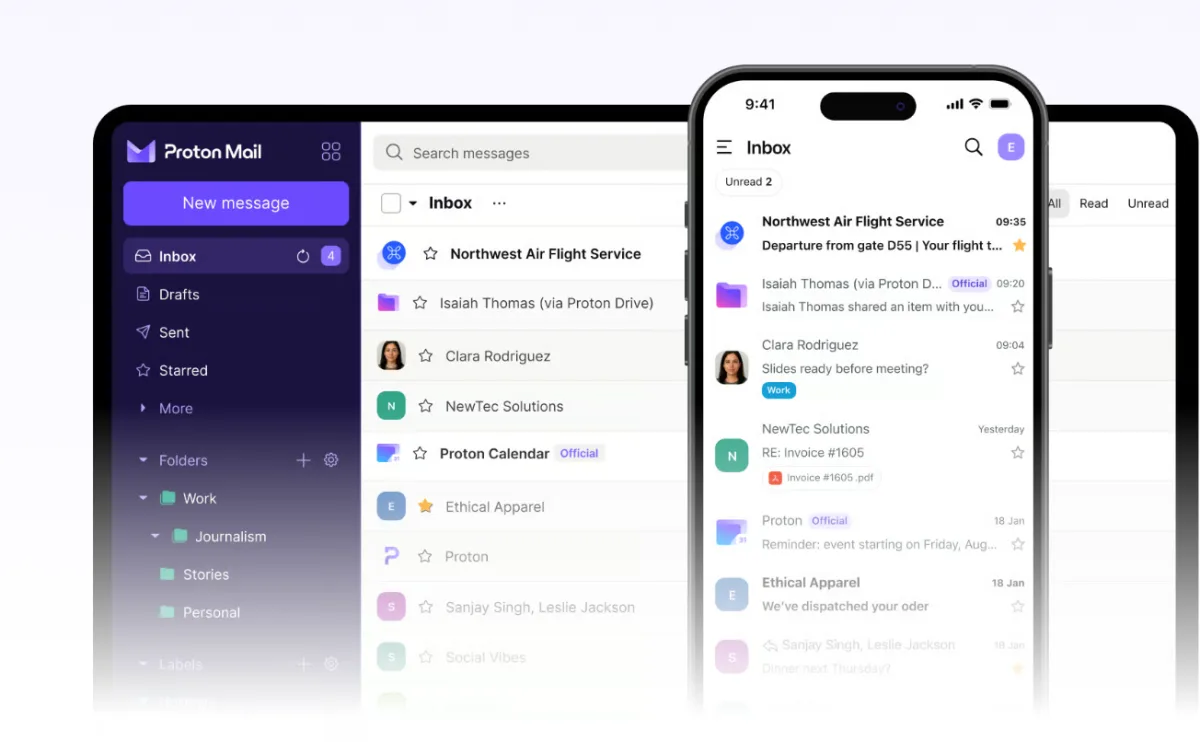
Proton Mail is an email service where your messages are stored with end-to-end and zero-access encryption — Proton itself can't access the contents of your emails, contacts or calendar. What matters most for freelancers is the combination of encryption and a custom domain: instead of @proton.me you communicate as you@yourname.com, which looks professional while your data sits under Swiss jurisdiction. There are native apps for iOS, Android, macOS and Windows, plus the web interface.
The key point: encryption and jurisdiction
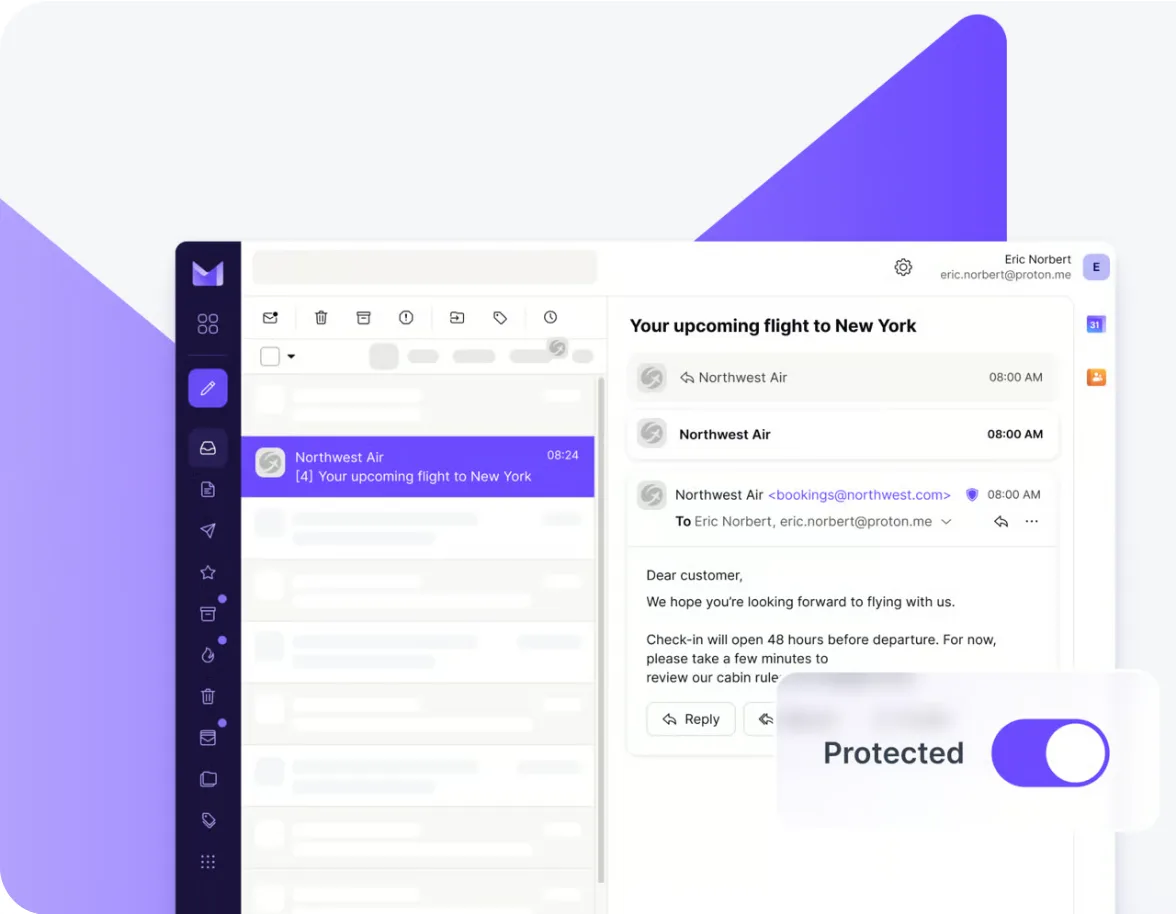
The core argument is end-to-end encryption combined with location. Proton is a Swiss company headquartered in Geneva; its servers sit in Switzerland, Germany and Norway. Switzerland deliberately sits outside US jurisdiction and is considered one of the strictest privacy environments in the world. Proton is subject to Swiss data protection law and can be used in a GDPR-compliant way for clients who need it. Anyone working with legal, health or coaching records gets a far stricter framework than with a US provider — and no obligation to hand over data under US warrants.
Custom domain: the reason for Mail Plus
The free plan gives you an encrypted @proton.me address and 1 GB of storage — fine to try, but no custom domain. For credible freelance communication, the jump to Mail Plus (from $3.99/month) is the real step: your own domain, 10 addresses, 15 GB of storage, plus catch-all, filters, auto-replies and 10 hide-my-email aliases that mask your real address when signing up for newsletters or accounts. That lets you run separate addresses like hello@ and billing@ under your domain without paying for multiple mailboxes.
The plans
Three individual tiers, and the decision is storage and domains. Free gives you one address and 1 GB — the free-forever entry point. Mail Plus is the jump for anyone with a business address: a custom domain, ten addresses and 15 GB. Proton Unlimited raises storage to 500 GB with three domains and bundles the whole Proton ecosystem — VPN, the Pass password manager, Drive storage and the Scribe AI writing assistant — which is only worth it if you would pay for two of those anyway. What the cards cannot show: monthly billing costs about a quarter more than annual, Scribe is a 14-day trial on Unlimited and then a paid add-on, and teams needing central administration are on the separate Business plans, covered in the Proton for Business review.
Where Proton Mail hits its limits
The strengths have a flip side. Because everything is encrypted, server-side full-text search is limited — Proton offers a local search instead, but it's less convenient than Gmail's. There are no native integrations into third-party workflows: you work in Proton's own ecosystem, not Google Docs attachments; Outlook or Apple Mail need the Bridge app, which paid plans include. And switching means a one-time import of your old mail, for which Proton ships a migration tool. If you're deep in Google, weigh whether the privacy gain is worth the convenience you give up.
Who is Proton Mail worth it for?
Proton Mail suits privacy-conscious freelancers and solo businesses who want a professional address on their own domain and value Swiss jurisdiction — especially those handling sensitive client data (legal, health, coaching, journalism). It's less of a fit for anyone tied to Google's collaboration and search. If you just want free encrypted email, start on the Free plan; if you want to look professional, take Mail Plus.
Proton Black Friday 2026: what to expect
Proton is one of the few vendors where November genuinely brings a special price. Proton excludes its business plans from it, explicitly.
| Year | What was offered | Window |
|---|---|---|
| 2024 | Promotion on the personal plans; evidenced for VPN at up to 75% on 24 months and 70% on 12 months | to 3 December |
| 2025 | Same level on the personal plans | November into early December |
| Rest of the year | 55% on 24 months, 50% on 12 months | ongoing |
| Proton Business and Workspace | no promotion in either year | — |
Proton's own Black Friday FAQ excludes the business plans in so many words, and the business page carried no occurrence of the term on either Black Friday itself. If you are licensing for a team, waiting through November gains you nothing.
Two things about how to read this. The specific percentages that can be evidenced on Proton's own pages concern the VPN plans; for the mail plans the campaign itself is documented, its depth is not. And Proton calculates the discount against the monthly list price, not against the regular annual price — which makes the saving look larger than it is next to an ordinary annual subscription.
The advertised monthly figure also assumes payment upfront for the full term.
What We Like About Proton Mail and What We Don't
Pros
- End-to-end encrypted, unreadable by Proton
- Custom domain from $3.99 per month
- Swiss jurisdiction, strong privacy laws
- Free forever plan available
- Native apps for iOS, Android, Windows
Cons
- Free plan: no custom domain, 1 GB
- Limited full-text search due to encryption
- No native Gmail/Outlook integration
Pricing
Free
Free
free forever
- 1 encrypted email address
- 500 MB storage, 1 GB after the starter checklist
- End-to-end encryption
Mail Plus
$3.99
per month (annual) · $4.99 monthly
- 1 custom domain (you@yourname.com)
- 10 email addresses, 15 GB storage
- 10 hide-my-email aliases, catch-all
Unlimited
$9.99
per month (annual) · $12.99 monthly
- 3 custom domains, 15 addresses
- 500 GB storage
- Proton VPN, Pass & Drive included
Prices may change — check the official website for current plans.
Price history
Checked Oct 19, 2026 · 2 plans unchanged since Sep 28, 2026
Alternatives by use case


Frequently Asked Questions
How much does Proton Mail cost?
Three tiers for individuals. The free entry has no custom domain, which is where it fails for professional use. The middle tier unlocks a custom domain, several addresses and far more storage; the top tier is only worth it if VPN, password manager and cloud storage are needed anyway.
Can I use Proton Mail with my own domain?
Yes — once you move to Mail Plus (from $3.99/month) or Unlimited, you can connect your own domain (e.g. you@yourname.com) and create professional addresses under it. The free plan doesn't allow this; there you only get a @proton.me address. For credible freelance communication, the custom domain is really the reason to step up to Mail Plus.
Proton Mail vs Gmail — which is better for freelancers?
Proton Mail is end-to-end encrypted by default and based in Switzerland — Proton itself can't read your content, which is ideal for sensitive client data. Gmail is free, deeply tied into Google's services and has better search, but Google can access content and falls under US law. Rule of thumb: privacy and data protection → Proton; maximum integration and free convenience → Gmail.
Where is Proton Mail data stored and is it private?
Proton is a Swiss company headquartered in Geneva, and its servers sit in Switzerland, Germany and Norway. Switzerland has some of the strictest privacy laws in the world and sits outside US jurisdiction, so Proton isn't subject to US data requests the way a US provider is. Data is end-to-end and zero-access encrypted, meaning Proton can't read your emails, contacts or calendar — a strong setup for anyone handling confidential client work.
Is Proton Mail free?
Yes. The Free plan is free forever and gives you an encrypted @proton.me address with 1 GB of storage — a solid way to try it. For a custom domain, more storage and multiple addresses you'll need Mail Plus or Unlimited. Paid plans don't have a classic trial, but they do come with a 30-day money-back guarantee.
Is Proton cheaper on Black Friday?
On the personal plans yes, and the gap is real: Proton's November promotion sat well above the discount level that stands on the pricing page all year in both recent years. It does not apply to the business plans — Proton's own Black Friday FAQ excludes them, and the business page carried no promotional notice on either Black Friday. One thing to keep in mind when doing the maths: Proton measures the discount against the monthly list price rather than the regular annual price, and the advertised monthly figure assumes paying for the whole term upfront.
Verdict
Proton Mail is the obvious pick for freelancers who care about privacy: end-to-end encrypted email from Switzerland, a professional you@yourname.com address from as little as $3.99/month, and a free plan for a risk-free start. If you handle sensitive client data — or simply don't want a US tech giant reading your mail — this is one of the most credible Gmail alternatives around. The trade-off is some adjustment: limited search, no Gmail ecosystem and a one-time migration of your old inbox. For most solo pros, the privacy gain outweighs it. Find more tools in our <a href="/en/email-marketing-tools/">email tools overview</a>.