Klaviyo Review 2026: Email & SMS Marketing for E-Commerce, Tested
Fastlancer Team · Updated: Sep 5, 2026

Short verdict
Ideal for
- Store owners on Shopify, WooCommerce, or BigCommerce who want more revenue from existing customers
- DTC brands and small teams running email and SMS from a single customer profile
- Freelancers managing email marketing for e-commerce clients who need the industry standard
- Data-driven marketers building segments on purchase behavior and predictive analytics
Not ideal for
- Freelancers without an online store — the strength is wasted
- Anyone who needs predictable cost as the list grows
- Businesses with strict EU data-residency requirements
- Entry price
- Free plan · paid from $20 / month
- Free to start?
- Yes — free plan forever with up to 250 profiles and 500 emails per month
- Stands out for
- E-commerce data at the core: Klaviyo merges store, email, and SMS data into one customer profile — segments and automations tap directly into order history and predictions.
What is Klaviyo?
Klaviyo is an email and SMS marketing platform built around a central customer profile: every order, site visit, and opened email lands in one record per contact. From that, you build segments like "bought twice, but not in the last 90 days" — and that is exactly what separates Klaviyo from classic newsletter tools that only know lists and open rates.
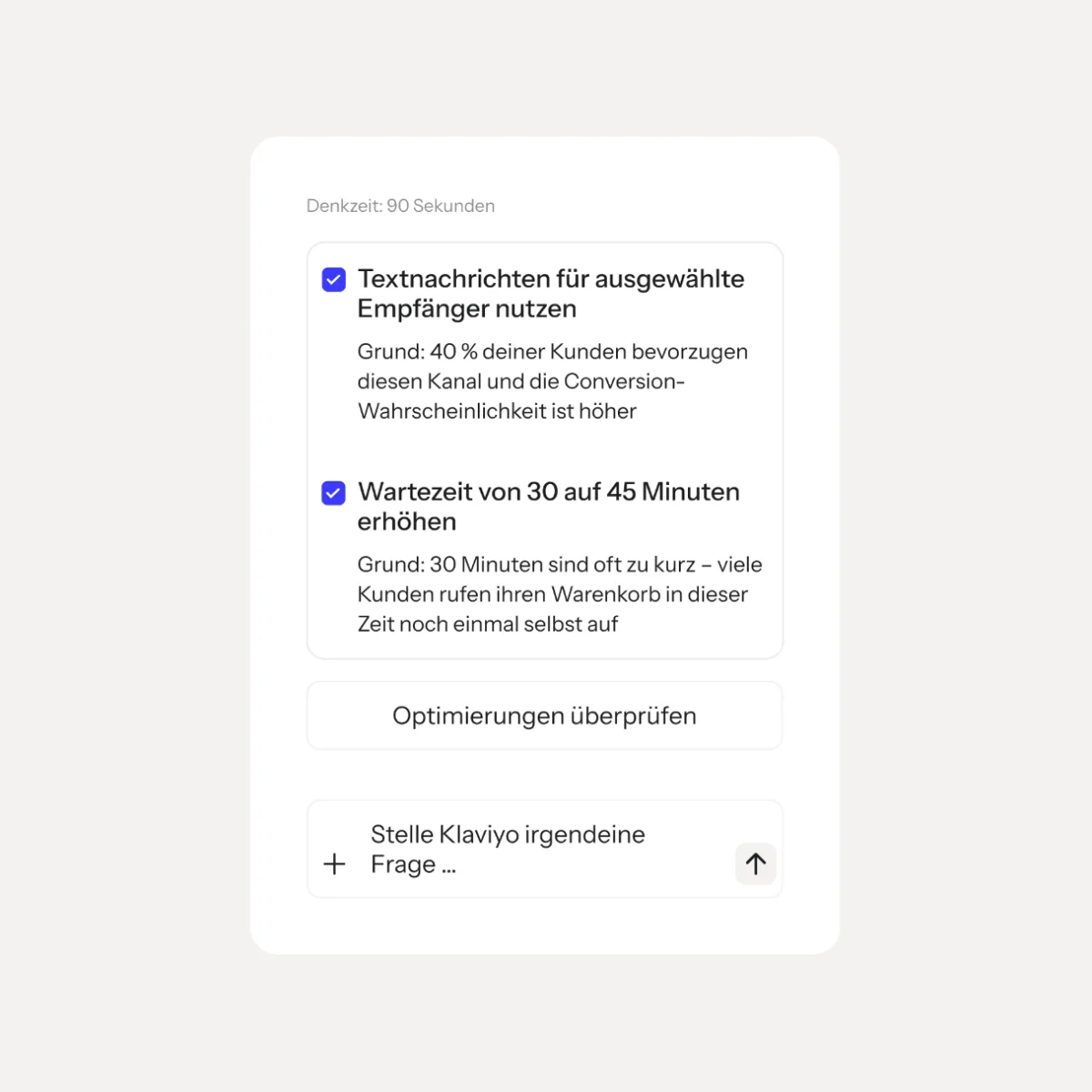
What started as a Shopify insider tip is now the standard at direct-to-consumer brands, with more than 205,000 customers (as of Q2 2026). For freelancers it matters in two roles: running your own store — or serving e-commerce clients, where Klaviyo is very often the tool those clients already use.
Key features at a glance
Flows: automations built on purchase behavior
The heart of Klaviyo is "flows" — automation sequences that react to store events: abandoned cart, first order, replenishment reminders, winbacks after inactivity. The templates come pre-wired; you adjust them in a visual editor with branches, delays, and A/B splits. Coming from a simple newsletter tool, this is where you feel the difference most: triggers understand order value, product category, and purchase probability.
Segmentation and predictive analytics
Segments update in real time and can reference any store data. On top, Klaviyo computes predictions per contact: expected next order date, customer lifetime value, churn risk. These predictive values are available in the standard plans once you have enough data (Klaviyo requires roughly 500 customers with order history and 180 days of order data) and work directly as segment conditions — say, "high lifetime value but high churn risk" for a targeted winback campaign.
SMS from the same profile
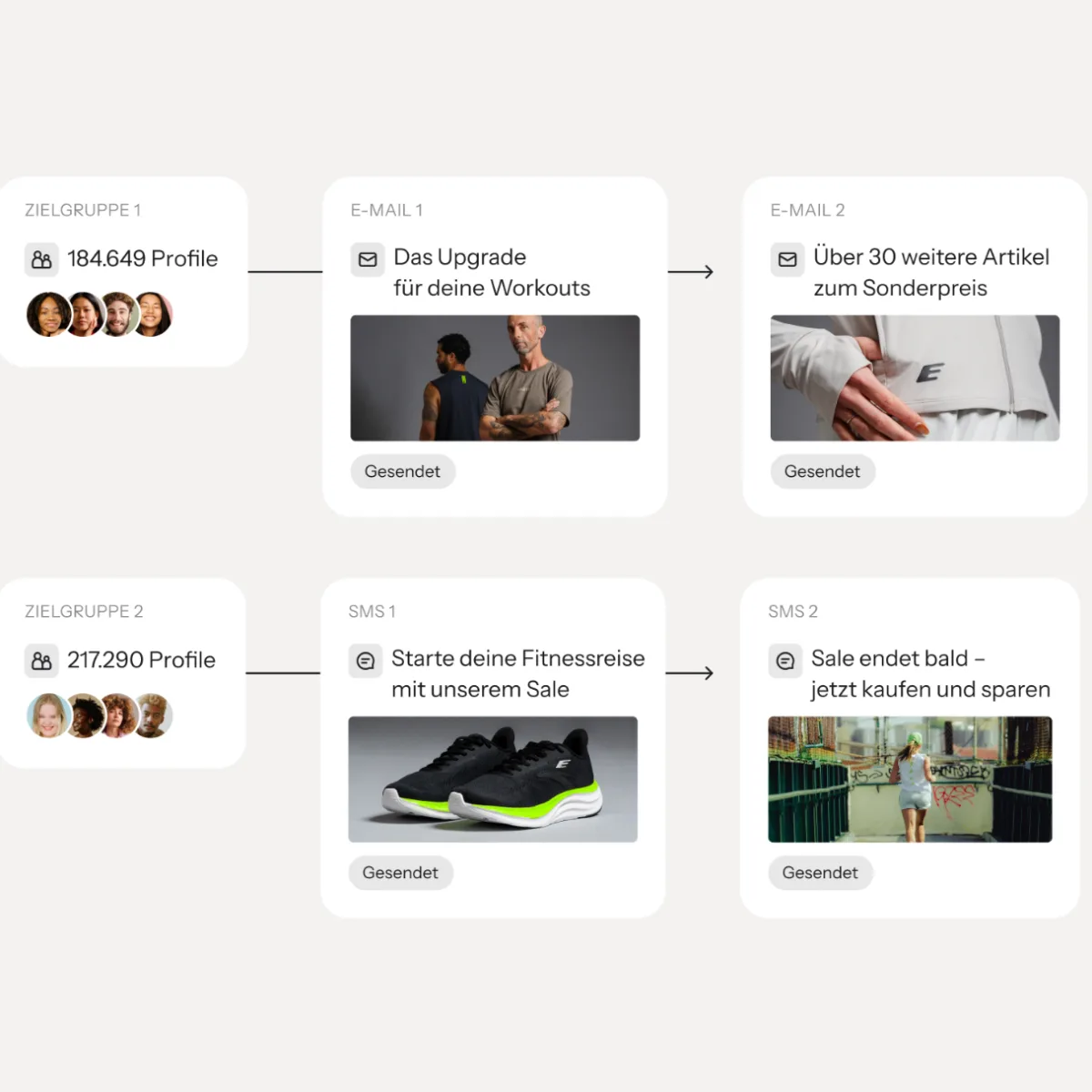
SMS is not a bolted-on second product — it uses the same profiles, segments, and flows. In practice that means an abandoned-cart flow can email first and follow up via SMS 24 hours later, with no syncing between two tools. SMS credits are billed by country and volume, so run the numbers for your market first.
Forms, landing pages, and reporting
Signup forms, popups, and simple landing pages are built in, including A/B tests. Reporting benchmarks your numbers against industry peers — useful for knowing whether your open rate is genuinely strong or merely average. Around that core, the platform keeps growing: product reviews (Klaviyo Reviews), free mobile push notifications, and a CDP module for larger setups all draw on the same profile record.
Pricing: understanding the profile model
Klaviyo does not charge by emails sent but by active profiles — every contact you could reach. The price therefore rises with list size, not with sending. On paid plans the send limit sits at roughly ten times your profile count.
The takeaway: list hygiene saves real money. If you never clean out inactive contacts, you pay every month for addresses that stopped opening long ago. By contrast, Brevo charges primarily by send volume and has tied each tier to a contact cap since 2025 — still the cheaper approach for large, low-activity lists.
Klaviyo vs. Brevo & co.
The decision is simpler than a feature comparison suggests: with a store, Klaviyo wins — no competitor in this price range matches the depth of store data in segments, flows, and predictions. Without a store, you pay for exactly those strengths without using them: for newsletters, course launches, and service marketing, Brevo (EU hosting, generous free plan) or Kit (creator focus) are the better and cheaper fit. For a broader comparison, see our email marketing overview.
What we like about Klaviyo and what we don't
Pros
- Deepest store integration on the market
- Strong automations with pre-built templates
- Predictive analytics in standard plans
- Free plan forever up to 250 profiles
- Email and SMS share one profile
Cons
- Pricing climbs fast as list grows
- Little value without an online store
- US data hosting, GDPR diligence needed
Pricing
Free
Free
forever, up to 250 profiles
- 500 emails per month
- $5/month worth of mobile messaging credits
- Drag-and-drop editor and basic segmentation
from $20
per month for up to 500 profiles
- Send limit of roughly 10× your profile count
- Flows, A/B testing, and predictive analytics
- 1,000 profiles ≈ $30, 5,000 profiles ≈ $100/month
Email + SMS
from $35
per month incl. SMS credits
- Everything in the Email plan
- SMS/MMS sending with dedicated credits
- SMS rates vary by country and volume
Prices may change — check the official website for current plans.
Alternatives by use case
- Brevo If there is no store behind the list and price matters
- ActiveCampaign If automation without a store is the need
- Kit If the products are digital rather than physical


Frequently Asked Questions
How much does Klaviyo cost?
The free plan costs nothing forever for a small list. Beyond it the price follows active profiles, not emails sent — so it rises with list size even if you rarely send. List hygiene is therefore a direct saving. SMS is priced as a separate package on top.
Is there a free version of Klaviyo?
Yes. The free plan has no time limit and includes up to 250 profiles, 500 email sends per month, and a small mobile messaging credit. Note that email support is only included for the first 60 days.
Klaviyo vs. Brevo — which is better for freelancers?
For pure service businesses and solo freelancers, Brevo is usually the better pick: cheaper, EU hosting, and a free plan with 300 emails a day for up to 100,000 stored contacts. Klaviyo earns its price the moment an online store is involved — no other tool in this price range puts store data to work in segments and flows the way Klaviyo does.
Does Klaviyo only work with Shopify?
No. Shopify is the deepest integration, but WooCommerce, BigCommerce, Magento, and 350+ other integrations are officially supported. Custom stores and data sources can connect via API.
Can Klaviyo be used in a GDPR-compliant way?
Klaviyo is a US company and hosts data in the US. GDPR-compliant use is possible via a data processing agreement and standard contractual clauses, and double opt-in plus consent tracking are built in. If you strictly need EU hosting, look at alternatives like Brevo.
Verdict
Klaviyo is the e-commerce standard for a reason: no tool in this price range ties store data this deeply into email and SMS. If you run an online store — or manage email marketing for clients who do — you get automations and segments that measurably add revenue, and the free plan lets you start without risk. Pure service businesses without a store, however, end up paying for strengths they never use and are better served by Brevo or Kit.