Zoho CRM: Powerful CRM for Freelancers and Small Teams
Tim Wittke · Updated: Aug 11, 2026
Short verdict
Ideal for
- Solo freelancers who want more than a pure pipeline tool
- Small sales teams (3–15 users) on a tight budget
- Existing Zoho Suite users (Mail, Books, Desk) wanting one unified stack
Not ideal for
- Anyone who wants to start without a learning curve
- Teams that depend on reliable support
- Entry price
- Free plan · paid from $14 / month
- Free to start?
- Free for up to 3 users forever + 15-day Enterprise trial
- Stands out for
- A fully-loaded CRM at a fraction of the Salesforce or HubSpot price — ideal for cost-conscious freelancers and small sales teams.
Customer relationship management sounds like a corporate problem — but the moment you have more than a handful of repeat clients, it becomes survival-critical for any freelancer or small business. Tracking leads in a spreadsheet means losing deals, missing follow-ups and never measuring your own sales behaviour. Zoho CRM has been the obvious answer for cost-conscious freelancers and small teams for years: a fully-featured CRM, free forever for up to 3 users, paid plans starting at $14/user. Here's what it actually delivers and where its limits show.
As of June 2026. Pricing is verified regularly — double-check on the official Zoho CRM pricing page before booking, as Zoho frequently runs time-limited discount campaigns.
What is Zoho CRM?
Zoho CRM is the CRM solution from Indian software conglomerate Zoho Corporation, which has been building cloud business software for over 25 years. The CRM is part of the Zoho One Suite — a bundle of 60+ integrated apps (Mail, Books, Desk, Projects, Campaigns, Inventory, Analytics and more) — but it also works standalone. With more than 250,000 customers worldwide, Zoho CRM is one of the most-used CRMs on the market.
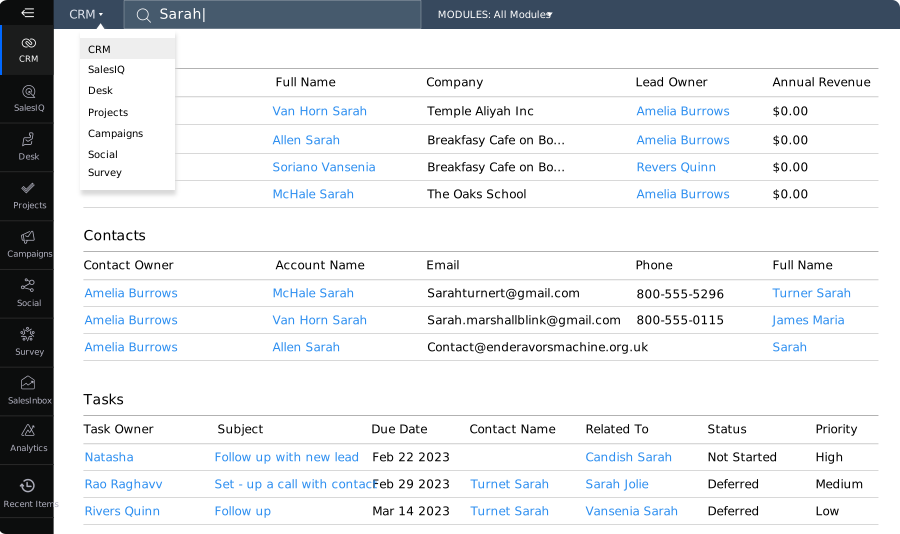
The platform covers the entire sales cycle: lead capture via web forms, email parsing and lead-gen tools; pipeline management with customisable stages and scoring; workflow automation with trigger-based actions; sales forecasting and reporting.
Video: "Who said CRMs can't be easy? | Zoho CRM" — the official product tour through the Zoho CRM interface. Shows pipeline, contact history and workflows in 90 seconds.
Key features of Zoho CRM
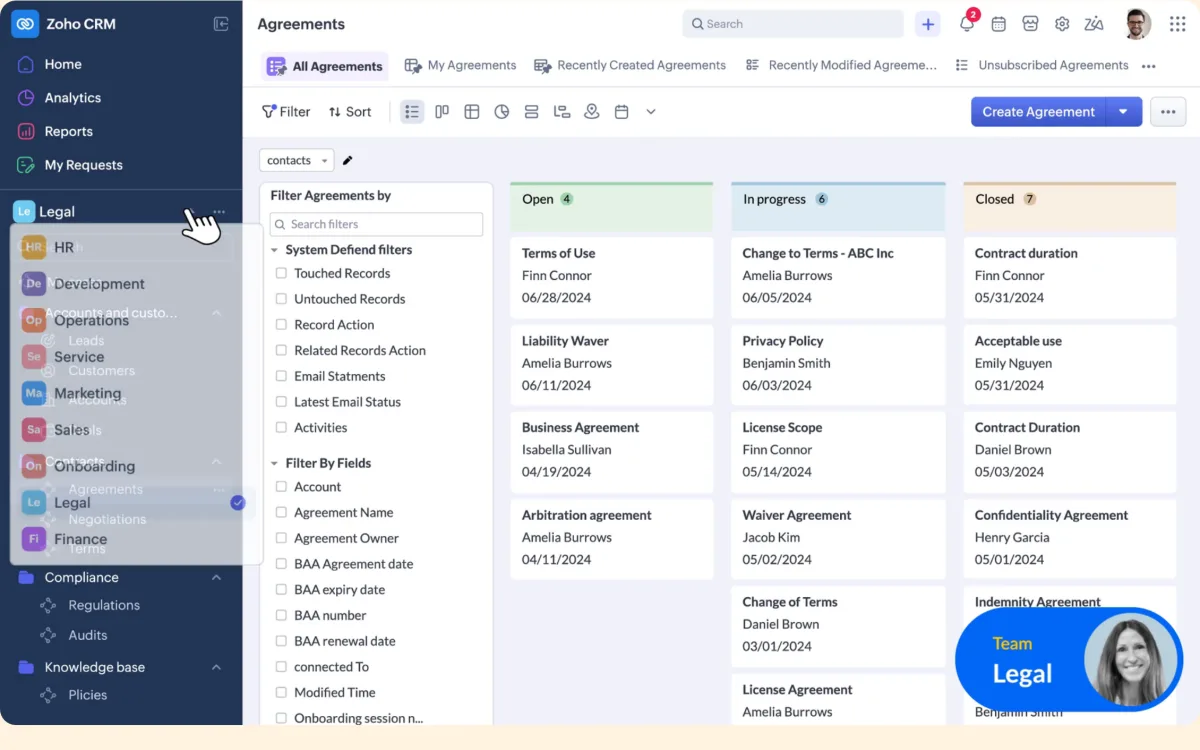
Sales pipeline management: Visual Kanban view with customisable stages, drag-and-drop, multi-pipeline support (Standard+) and scoring rules for lead quality.
Zia AI assistant (Enterprise+): Lead and deal scoring, automatic anomaly detection, sales forecasts, voice commands and sentiment analysis on inbound emails.
Workflow automation: Trigger-based rules (e.g. "if lead status = hot, send email to assigned rep") — available from Standard upward, with higher limits per plan.
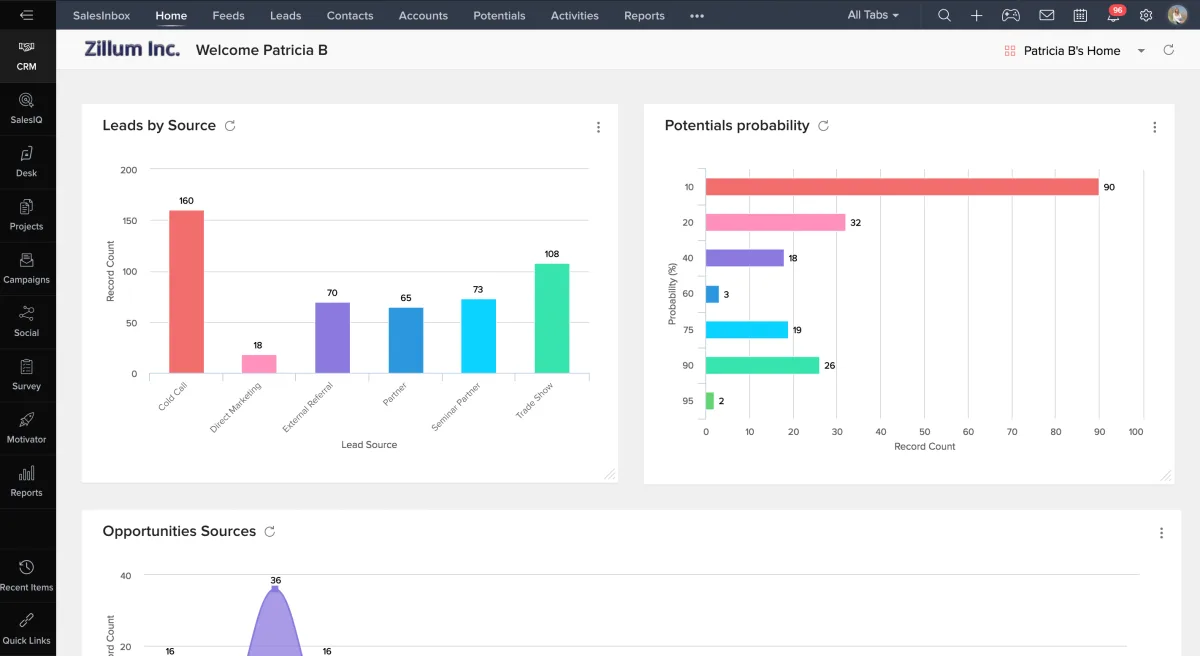
Zoho Suite integration: Deep ties with Zoho Books (accounting), Zoho Mail, Zoho Desk (support) and Zoho Campaigns (email marketing) — single sign-on and shared contact records.
500+ third-party integrations: Google Workspace, Microsoft 365, Slack, Mailchimp, Zapier, QuickBooks, Shopify and many more via the Zoho Marketplace.
Mobile apps (iOS + Android): Near-full feature parity with desktop, including calls, voice-to-text notes, geofencing for field sales and offline mode.
Multi-channel communication: Email, telephony (via Zoho Voice or integration), live chat and social — all touchpoints inside a single contact history.
Custom configuration: Custom modules, fields, layouts, workflows and validation rules — buildable without code in the no-code editor (Professional+).
Zoho CRM pricing in 2026
Five plans, all per user per month in US dollars; monthly billing typically adds 20 to 30 %, and the top tier is annual-only.
Two thresholds decide it. The free plan carries up to three users with leads, contacts, deals and standard reports — but no automation at all. Anyone who wants automated workflows needs the first paid tier, which is the default for solo professionals and small teams. The second threshold is the AI: Zia, with lead scoring, forecasting and anomaly detection, only arrives two tiers above that. Worth knowing if the AI is why you came.
On top of the forever-free plan there is a 15-day trial of the AI tier — the sensible way to road-test it before committing. Multi-year contracts cut the price further.
Pros & Cons
Pros
- Free 3-user plan forever
- Standard $14/user, cheapest full-featured CRM
- Zia AI assistant for lead scoring
- Deep Zoho One Suite integration
- Mobile apps with near-full desktop parity
Cons
- Steep learning curve, cluttered interface
- Inconsistent support, slow response times
- Automation and AI gated behind paid tiers
Who should use Zoho CRM?
Zoho CRM is the right pick for three clear profiles. Solo freelancers who want more than a pure pipeline tool — workflow automation, mobile-first usability, multi-channel communication — and whose volume fits inside the free plan. Small sales teams (3–15 users) on a tight budget, where HubSpot or Salesforce would quickly cost hundreds of dollars per month: Zoho CRM Standard is just $70/month for a 5-person team. And existing Zoho Suite users (Mail, Books, Desk) who want everything from one vendor under a single login.
It's a worse fit if you need a highly polished interface (HubSpot is clearly ahead there), enterprise setups with hundreds of custom integrations (Salesforce has the larger app ecosystem) or are a solo salesperson who just wants a clean pipeline with zero setup — Pipedrive is the faster pick there.
Zoho CRM vs alternatives
HubSpot — the UX champion with unlimited contacts in the free plan and the strongest marketing automation. Significantly more expensive on paid plans, but a more mature interface and better onboarding. Pick this if polish and an integrated content hub matter more than price.
Pipedrive — the specialised sales pipeline tool. Leaner and more intuitive than Zoho CRM, but with less reach outside pure sales. Best pick for sales-only teams under 10 users who want to start fast.
Salesforce — the market leader with the largest app ecosystem and deepest customisation. Makes sense from 50+ users with a dedicated CRM admin. For freelancers and small teams, usually overkill and overpriced.
Capsule CRM — lean British CRM with a generous free plan for solo freelancers. Less reach than Zoho but very tidy and free of learning curve. A minimalist alternative.
Pricing
Free
Free
up to 3 users forever
- Leads, contacts, deals and tasks
- 1 GB storage and standard reports
- Mobile apps (iOS + Android)
Standard
$14
per user/month (annual billing)
- Sales pipelines and scoring rules
- Workflow automation (5 rules/module)
- Mass email and templates
Professional
$23
per user/month (annual) — most popular
- Everything in Standard
- Inventory management (products, quotes, orders)
- Workflow automation (10 rules/module)
Enterprise
$40
per user/month (annual billing)
- Everything in Professional
- Zia AI assistant (lead scoring, forecasts, anomalies)
- Multi-user portals for customers and partners
Ultimate
$52
per user/month (annual only)
- Everything in Enterprise
- Advanced BI with Zoho Analytics
- Increased storage and API limits
Prices may change — check the official website for current plans.
Alternatives by use case




Frequently Asked Questions
What is Zoho CRM?
Zoho CRM is a cloud-based customer relationship management platform from Indian software giant Zoho Corporation. It covers the full sales cycle — lead capture, pipeline management, workflow automation, and forecasting powered by the in-house AI assistant Zia. Zoho CRM is part of the Zoho One Suite (60+ integrated business apps) and has positioned itself for years as the affordable alternative to Salesforce and HubSpot.
How much does Zoho CRM cost in 2026?
Five plans, all per user per month in US dollars; monthly billing adds 20 to 30 %. Two thresholds decide it: the free plan carries up to three users but has no automation at all, which arrives on the first paid tier — and the AI features only two tiers above that.
Is Zoho CRM really free?
Yes — Zoho CRM offers a forever-free plan for up to 3 users with no time limit. You get leads, contacts, deals, tasks, 1 GB of storage, standard reports, and the full mobile apps. What's missing: workflow automation, Zia AI, mass email, advanced reports and most third-party integrations. It's enough for solo freelancers or mini-teams with a manageable pipeline. If you need automation or more than 3 users, you'll have to upgrade to Standard.
Zoho CRM or HubSpot — which is better?
Both are top-tier CRMs for different profiles. HubSpot wins on unlimited contacts in the free plan, a polished interface and deeper marketing automation — but paid tiers are expensive (Starter from $20, Professional $100+). Zoho CRM is significantly cheaper (Professional $23 vs $100+), gives you more features per dollar and a broader suite ecosystem. Pick HubSpot if you want marketing automation and a polished content hub; pick Zoho CRM if cost matters and you want deep sales and pipeline tooling. More in our HubSpot review.
Zoho CRM or Pipedrive — which fits whom?
Pipedrive is the specialised sales pipeline tool — lean, intuitive, fast to set up. If you only need to manage deals and pipelines, it's the better fit. Zoho CRM is the broader platform with marketing, service, workflow automation and AI features — steeper learning curve but far more headroom. Rule of thumb: pure sales team under 10 users → Pipedrive; growing business with marketing and support components → Zoho CRM.
Zoho CRM vs Salesforce — is the price gap worth it?
For solo freelancers and teams under 50 users: usually not. Salesforce is the market leader with the largest app ecosystem and deepest customisation, but setup, maintenance and licences quickly cost 3–5× what Zoho does. Zoho CRM covers 80–90% of Salesforce's feature set at a fraction of the price. Salesforce only pays off once you have dedicated CRM admins, complex workflows with 50+ users, or integrations only the Salesforce ecosystem supports.
Is Zoho CRM GDPR-compliant?
Yes — Zoho is GDPR-compliant and additionally holds ISO 27001, SOC 2 and PCI DSS certifications. European customers can explicitly choose an EU data center (Netherlands, Ireland) so all data stays inside the EU. For US/UK customers, US and UK data centers are also available. Data Processing Agreements (DPAs) can be downloaded from the Zoho customer portal.
Verdict
Zoho CRM remains the price-performance benchmark in the CRM market in 2026. If you want a fully-featured CRM with workflow automation, AI capabilities and surprisingly strong mobile apps at a fraction of the Salesforce or HubSpot cost, this is the obvious pick. Solo freelancers can often stay on the free plan; sales teams should start on the first paid tier, because that is where automation begins at all. The full Zia AI feature set sits two tiers above. The honest weaknesses: the interface is not as polished as HubSpot, the learning curve is steeper than Pipedrive, and support on the cheaper plans is below average.