Moz Pro: SEO Software for Keyword Research, Rank Tracking and Links
Tim Wittke · Updated: Sep 4, 2026
Short verdict
Ideal for
- SEO beginners who need the industry-standard Domain Authority metric in their reports
- Freelancers and small agencies wanting a manageable, affordable SEO suite
- Solo consultants who want to track rankings and run simple site audits without Semrush pricing
- Content creators who value keyword research with clear Difficulty and Priority scores
Not ideal for
- Anyone who needs deep backlink analysis
- Users making many keyword queries on lower plans
- People who want more than a week to trial it
- Entry price
- From $49 / month
- Free to start?
- Yes — 7 days, Medium plan (monthly) only, credit card required; rolls into a paid subscription unless cancelled
- Stands out for
- The SEO suite behind the industry-standard Domain Authority metric — keyword research, rank tracking and link analysis in one beginner-friendly, comparatively affordable package.
What is Moz Pro?
Moz Pro is one of the oldest SEO platforms on the market and the company behind the Domain Authority (DA) metric — the 0-to-100 score that nearly every agency and SEO report cites today. The suite bundles the four SEO fundamentals into one clean interface: keyword research, rank tracking, technical site audits and backlink analysis. On top sit the free MozBar browser extension and a deep library of learning material, from Moz Academy to the guides.
MozRank, MozTrust and Domain Authority: which Moz score still exists?
MozRank and MozTrust no longer exist. Moz retired both when it rebuilt its link index and launched Link Explorer in 2018, and in the API the fields have since been marked deprecated and return nothing. If a third-party tool still shows you a "MozRank" number today, it is re-deriving an old-style score on its own — it is not a value Moz maintains or publishes.
| Score | Scale | Status | What it measured |
|---|---|---|---|
| MozRank | 0–10, logarithmic | Retired 2018 | Raw link popularity, modelled on Google's original PageRank |
| MozTrust | 0–10, logarithmic | Retired 2018 | How close a page sat to a set of trusted seed sites |
| Domain Authority (DA) | 1–100 | Current | Machine-learning prediction of how likely a whole domain is to rank |
| Page Authority (PA) | 1–100 | Current | The same prediction for a single URL |
| Spam Score | 0–100 % | Current | Share of comparable sites that were penalised or removed by Google |
Two things are worth being blunt about. First, Domain Authority is not a Google ranking factor — it is Moz's own model predicting how a domain might perform, and Google has never used it. It is useful for comparing link prospects against each other, not as a target to optimise. Second, DA is relative and rescaled: when Moz refreshes the index, scores shift across the whole web, so a drop from 34 to 31 often means the scale moved, not your site.
Keyword research and rank tracking
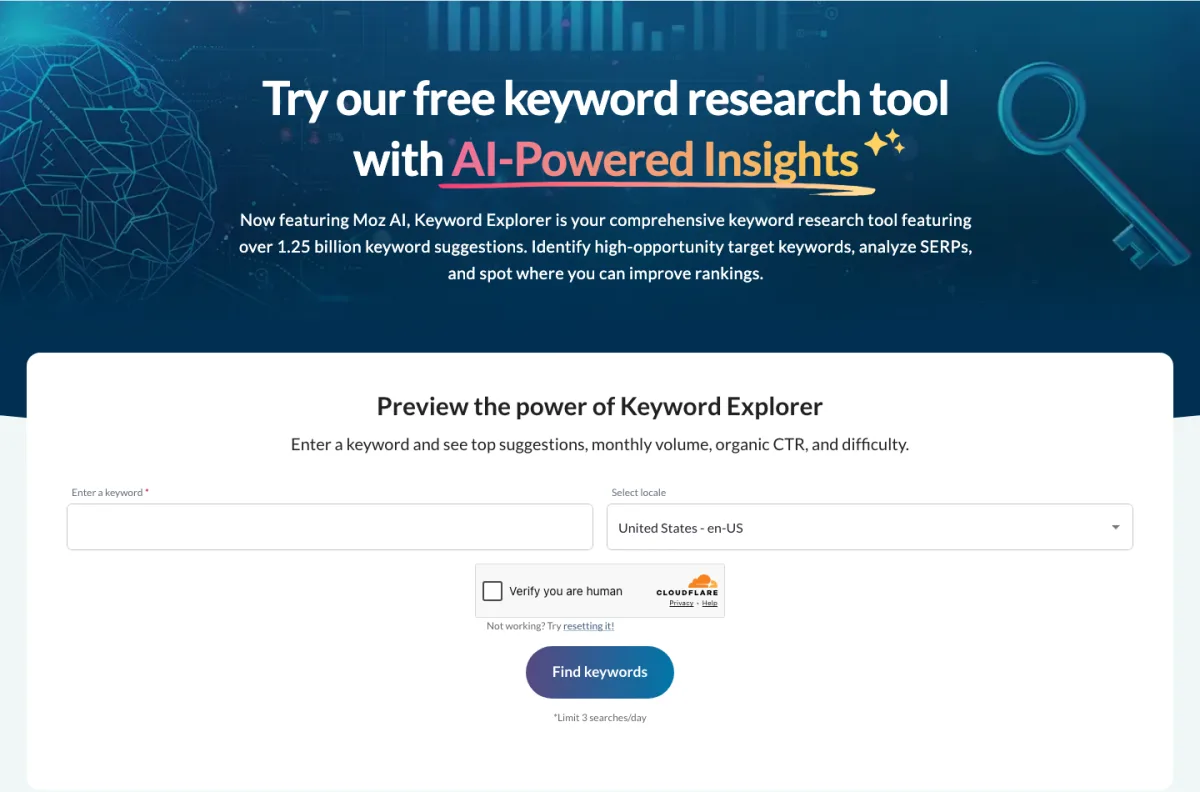
The Keyword Explorer gives every search term a search volume, a Keyword Difficulty from 1 to 100 and a Priority score that folds volume, difficulty and click-through likelihood into a single recommendation — that removes a lot of guesswork for beginners. Watch the budget: the number of keyword queries is tiered, and the Standard plan is tight at roughly 150 per month.
What the Moz rank tracker actually does
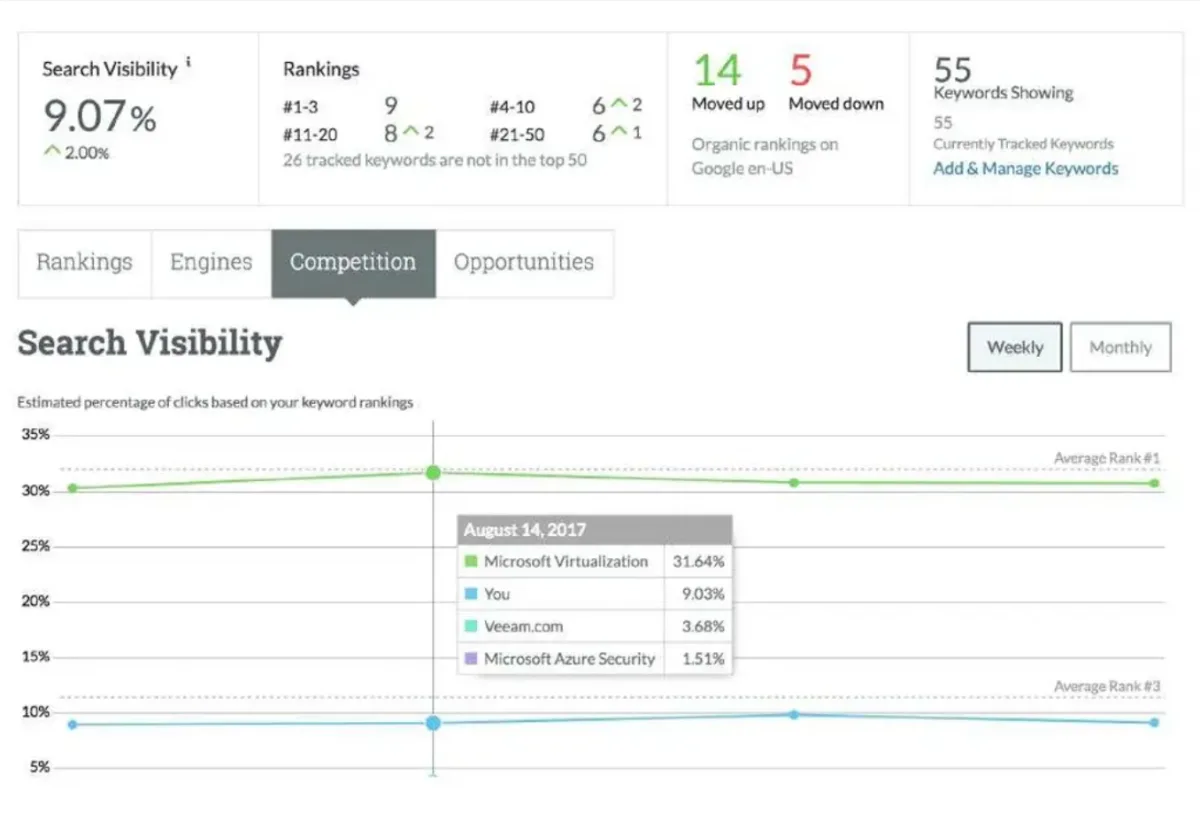
Rank tracking sits inside a Campaign — you add a site, Moz crawls it weekly and reports where your tracked keywords stand. It follows positions on desktop and mobile separately, covers local rankings, and lets you watch up to three competitors per campaign alongside your own trend line.
The limit that decides which plan you need is the tracked-keyword count, not the feature set. For a freelancer tracking their own site plus two or three client projects, Standard is the realistic floor.
Updates are weekly, not daily. That is the honest trade-off against dedicated rank trackers: fine for reporting a monthly trend to a client, too slow if you need to watch a launch move hour by hour.
The SEO checker: Site Crawl and On-Page Grader
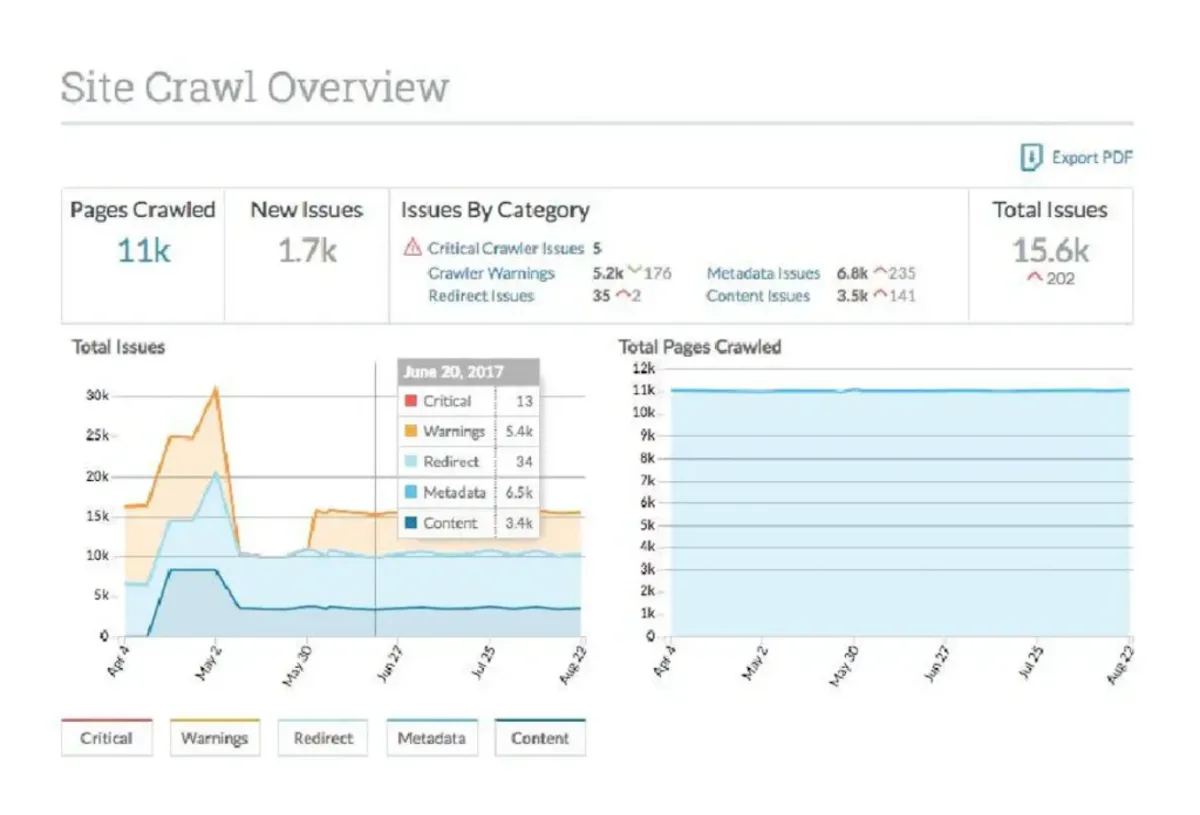
What people usually mean by "Moz SEO checker" is one of two tools. Site Crawl audits your whole site every week and sorts what it finds by severity — broken links, duplicate content, missing meta descriptions, redirect chains — so you get a worked list rather than a raw dump. On-Page Grader scores a single URL against one target keyword out of 100 and names the specific fixes.
The free version of this is the MozBar browser extension: it shows DA and PA for any page you visit and for every result in a SERP. For quickly sizing up whether a link prospect is worth approaching, that alone is worth installing, and it costs nothing.
Link analysis and site audits
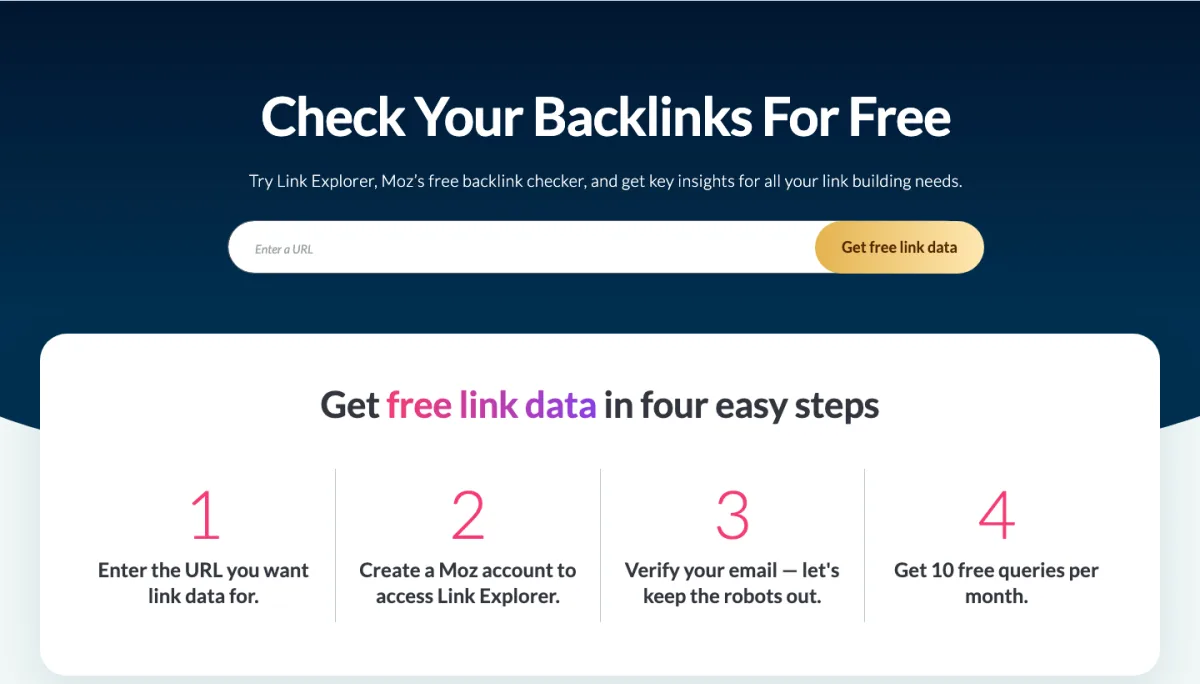
The Link Explorer shows your backlink profile, referring domains, Spam Score and the Page Authority of individual pages. Moz keeps a large but not the largest index here — for pure backlink depth Ahrefs is ahead, but for standard analysis and watching your own link growth Moz does the job.
Moz Pro pricing 2026: $49 to $299 a month
Two numbers decide the tier: tracked keywords and number of sites. The entry plan covers your own site or one small client project; from three projects Standard becomes the floor, and the plan Moz pushes as most popular is the third, because that is where the keyword allowance jumps from 300 to 1,500. Extra capacity is sold in blocks, which is often cheaper than moving up a tier.
The trial is the trap. It exists only on the middle plan billed monthly — 7 days with a credit card on file, after which the subscription continues unless you cancel at least 24 hours before it ends. The 30-day trial of earlier years is gone. Paying yearly saves 20 % and is billed twelve months up front; all amounts are net US dollars.
Moz vs. Semrush vs. Ahrefs
The three are not interchangeable. Semrush is the broad marketing suite — SEO, PPC, content and social in one — and starts at roughly $140 a month; Ahrefs has the deepest backlink index and the strongest site explorer, from $129 for Lite, plus a stripped-down Starter plan at $29. Moz is the cheapest entry among the full suites and the easiest to read, with the metric clients already know. The honest split for a freelancer: Moz if you report Domain Authority and track a handful of sites, Ahrefs if link data is your daily work, Semrush if you also run ads or content at scale.
Who is Moz Pro right for?
For freelancers, solo consultants and small agencies who take SEO seriously but do not need a full-price cockpit, Moz is the affordable, understandable entry point — especially since clients already know Domain Authority. Find more options in our SEO tools overview.
What We Like About Moz Pro and What We Don't
Pros
- Industry-standard Domain and Page Authority metrics
- Cheaper entry point than Semrush or Ahrefs
- Beginner-friendly interface with clear scoring
- Strong learning resources, Moz Academy and MozBar
- All core SEO tools in one suite
Cons
- Backlink analysis trails Ahrefs
- Tight keyword-query limits on lower plans
- Trial shrunk from 30 to 7 days
Pricing
Starter
$39
per month billed annually · $49/mo monthly
- 1 campaign (tracked site)
- 50 tracked keywords
- Keyword Explorer and Link Explorer
Standard
$79
per month billed annually · $99/mo monthly
- 3 campaigns
- 300 tracked keywords
- Site Crawl and On-Page Grader
Medium
$143
per month billed annually · $179/mo monthly
- 10 campaigns
- 1,500 tracked keywords
- 5,000 keyword queries/month
Large
$239
per month billed annually · $299/mo monthly
- 25 campaigns
- 3,000 tracked keywords
- 15,000 keyword queries/month
Prices may change — check the official website for current plans.
Price history
Checked Oct 21, 2026 · 3 plans unchanged since Sep 14, 2026
Alternatives by use case
- SE Ranking If a complete suite at a smaller price is the goal
- Serpstat If the budget sits under a hundred dollars a month
- Diginius If SEO and ads belong in one report


Frequently Asked Questions
How much does Moz Pro cost?
Four plans, tiered by tracked keywords and number of sites; annual billing saves 20 % and is charged twelve months up front. All amounts are net US dollars. Watch the trial: it exists only on the middle plan billed monthly, runs seven days with a card on file, and continues automatically unless cancelled at least 24 hours before it ends.
Is there a free version of Moz Pro?
There is no permanent free plan, but Moz offers a 7-day free trial — but only on the Medium plan billed monthly, with a credit card on file. Unless you cancel at least 24 hours before it ends, it rolls into a paid Medium subscription at $179 a month; Moz emails a reminder one day before. The old 30-day trial is gone. What stays free are individual tools like the MozBar extension and a limited free allowance in Keyword Explorer.
What is MozRank?
MozRank was Moz's link-popularity score on a logarithmic 0–10 scale, modelled on Google's original PageRank. It no longer exists. Moz retired MozRank together with MozTrust in 2018, when it replaced Open Site Explorer with Link Explorer and rebuilt its link index — in the Moz API the corresponding fields have since been marked deprecated and return nothing. The scores that replaced them are Domain Authority (1–100, for a whole domain) and Page Authority (1–100, for a single URL). If a third-party tool still displays a "MozRank" figure today, it is calculating an old-style score itself; it is not a value Moz publishes or maintains.
What is a good MozRank or Domain Authority score?
Since MozRank is retired, the question in practice is about Domain Authority — and there is no universal target, because DA is relative and rescaled. It predicts how likely a domain is to rank compared with other domains, so the same site can drop from 34 to 31 purely because Moz refreshed its index and the whole scale shifted. Useful ways to read it: compare a link prospect against the sites already linking to you, or track your own trend over months rather than weeks. What DA is not: a Google ranking factor. Google does not use it and never has — it is Moz's own model.
Does Moz have a rank tracker, and how often does it update?
Yes. Rank tracking runs inside a Campaign: you add a site, Moz crawls it and reports your tracked keywords' positions, split by desktop and mobile and including local results, with up to three competitors tracked alongside. The updates are weekly, not daily — good enough for a monthly client report, too slow if you need to watch a launch move hour by hour. The deciding limit between plans is the keyword count: Starter covers 1 campaign and 50 keywords, Standard 3 campaigns and 300. Beyond that Moz sells blocks at roughly $20/month per 200 extra keywords and $10/month per extra campaign.
What is Domain Authority and how reliable is it?
Domain Authority (DA) is a Moz-invented 0-to-100 score that estimates a domain’s ranking strength. It is not a Google ranking factor, but it has become a shared language across the industry — almost every pitch and report references it. As a relative comparison between domains it is useful; as absolute truth it is not.
Moz Pro vs Semrush — which is better?
Semrush is the broader all-in-one suite (SEO, PPC, content, social, competitive analysis) with larger databases, but it starts around $140/month. Moz Pro is leaner, cheaper and known for Domain Authority. Rule of thumb: if you only need SEO basics on a small budget, start with Moz; if you want a full marketing cockpit with ad and content tools, choose Semrush. For deep backlink analysis, Ahrefs beats both.
Who is Moz Pro right for?
Freelancers, solo consultants and small agencies who take SEO seriously but do not want to pay $140/month for Semrush. The Starter plan covers keyword research, rank tracking for one site and site audits — enough to run your own site or a client project or two cleanly. Once you are tracking ten clients or running deep competitor analysis, you quickly grow into Medium or Large.
Verdict
Moz Pro is the pragmatic way into SEO: familiar metrics, a clean interface and an entry price below the full Semrush and Ahrefs suites. Domain Authority is the industry’s shared language, and the core tools — Keyword Explorer, Link Explorer, rank tracking, Site Crawl — are plenty for most freelancers and small agencies. The limits show up in depth: backlink analysis that trails Ahrefs in practice, tight query allowances on the lower plans and no PPC or content module like Semrush. If you want an affordable, understandable SEO toolkit, Moz is a solid pick; if you need maximum data depth, you will pay more elsewhere and get it.