Deel vs Rippling (2026): EOR, Global Payroll and Contractors Compared
Fastlancer Team · Updated: Oct 25, 2026

You have one person to hire in a country where your company does not exist, or a handful of freelancers spread over three continents, and two names keep coming up. Both promise to hire, pay and manage people anywhere from one dashboard.
The useful question is not which brand is better. It is which of three legal setups you actually need — an employer of record, payroll on your own entity, or a contractor relationship — and which of the two vendors is built around that setup. Get that answer first and the choice mostly makes itself.
Straight to it: The three setups · Side by side · Pricing · Which one fits you · Verdict
Short version
EOR, global payroll and contractors: three setups, not three features
Both vendors sell all three, and both put them on one platform. That makes them look like modules of one product. Legally they are three different relationships, and the question of who carries the risk decides which one you need.
| Question | Employer of Record (EOR) | Global payroll | Contractor management | Contractor of Record |
|---|---|---|---|---|
| Who is the legal employer or contracting party | the provider, in that country | your own local entity | you | the provider |
| Do you need a company in that country | no | yes | no | no |
| Who carries the employer duties | the provider | you, the provider runs the process | nobody, it is not employment | nobody, it is not employment |
| Who carries the misclassification risk | not applicable | not applicable | you | the provider |
| Typical case | first employee in a new country | an established team where you have an entity | independent freelancers abroad | long-running roles close to the employee line |
Read the table from the bottom up. If the person is a genuine freelancer with several clients, contractor management is enough and everything above it is money spent on a problem you do not have. If the role has drifted into something that looks like employment, Contractor of Record moves the risk off your books. If it is employment, the EOR is the way to hire without founding a company — and global payroll only becomes relevant once you have founded one.

Deel vs Rippling side by side
Facts from both vendors' own product and pricing pages, checked on 25 October 2026. Where a figure is a vendor claim that cannot be checked from outside, the table says so.
| Criterion |  Deel |  Rippling |
|---|---|---|
| Where it started | paying contractors across borders | US HR, payroll and IT on one employee record |
| EOR coverage | 130+ countries, largely through its own entities | around 80 countries, own entities plus partners |
| Global payroll on your own entity | 130+ countries, own calculation engine in 50+ | offered; own engine in its highest-volume countries, 10 natively per Rippling |
| Contractor payments | 120+ currencies, 15+ payout options incl. Wise, PayPal, crypto, Deel Card | 185+ countries, 50+ local currencies |
| Contractor of Record | yes | yes |
| US PEO | yes, all 50 states | yes |
| HRIS | Deel HR, three tiers | core of the platform |
| IT: devices, access | Deel IT: device shipping and retrieval, MDM, access management | device management plus identity and access management |
| Spend: cards, expenses, bill pay | expense add-on | cards, expenses and bill pay |
| Immigration and visas | Deel Mobility, work permits in 75 countries | not a product line |
| Published prices | per product, per head | platform entry point only, rest by quote |
| Contract term | month to month per the pricing FAQ | not stated |
| Size it is aimed at | from the first contractor upward | roughly 50 to 10,000 employees, per Rippling |
| G2 rating | 4.7 from 15,700+ reviews | about 4.8 from 10,000+ reviews |
| Trustpilot rating | 4.6 from 9,700+ reviews | 4.6 from 2,600+ reviews |
The pattern is clear once you group the rows. Everything about crossing a border — employing, paying, relocating — leans towards Deel. Everything about running the people you already have — their laptops, their app logins, their company cards — leans towards Rippling. Both now sell the other half, but each sells it as the second half.
Pricing: one publishes, one quotes
This is the most practical difference, because it decides how early you can do the arithmetic.
| Product, per month | Deel | Rippling |
|---|---|---|
| Contractor management | from $49 per contractor | quote |
| Contractor of Record | from $325 per contractor | quote |
| Employer of Record | from $599 per employee | quote; Rippling's blog has cited from $499 |
| Global payroll, own entity | from $29 per employee | quote |
| US PEO | from $110 per employee, $125 on the overview card | quote |
| HR platform | from $5 per employee | from $8 per employee plus a base fee |
Deel's list lets you price a hire on your own before anyone calls you. Rippling's model is modular — you assemble products and get one quote — which can come out cheaper or more expensive, but you only learn which after the sales conversation. Neither approach is dishonest. They simply move the moment of certainty.
Two things the price list does not show. An EOR fee sits on top of the salary and the local employer costs, not instead of them, so the real monthly cost of an EOR employee is the salary plus statutory contributions plus the fee. And the cheapest line on Deel's list is not the one people quote: the HR tier, which matters if you only need a system of record for a small team.
Where Deel is stronger
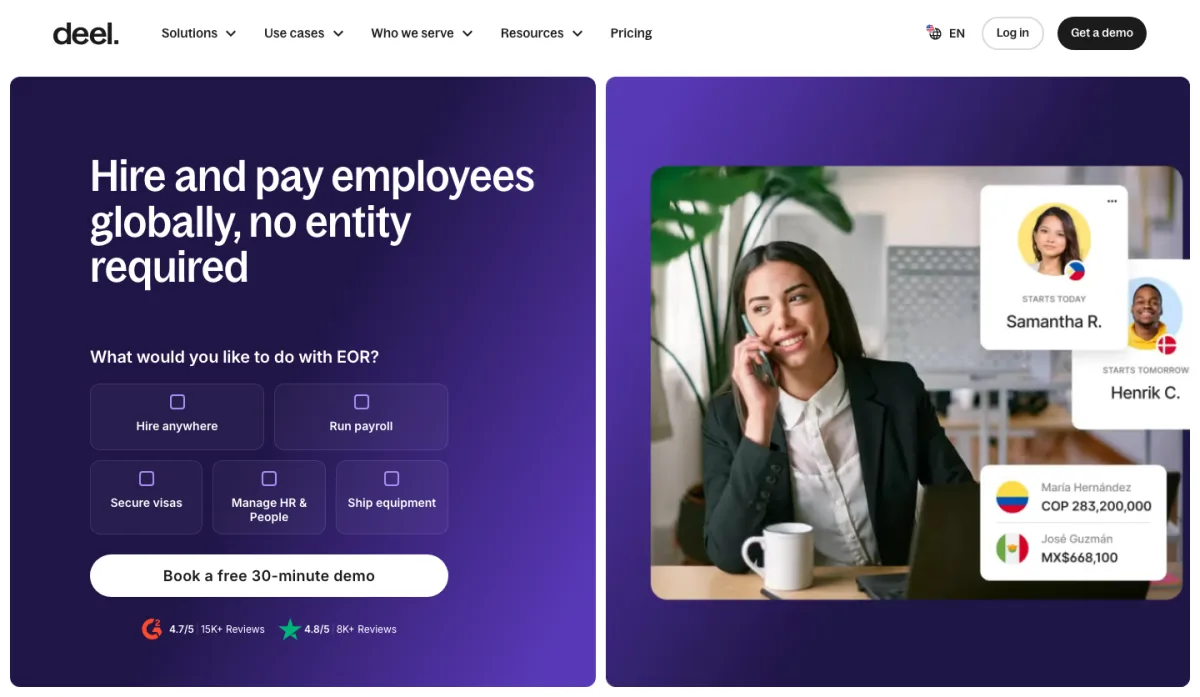
Reach for employment. The gap in EOR countries is the single largest difference between the two, and Rippling's own German comparison concedes it. If your hiring plan includes countries outside the obvious markets, check Rippling's list first — with Deel the answer is more often yes.
Paying contractors the way they want to be paid. Freelancers abroad care about how money arrives as much as about the rate. Deel's range of payout methods, its card and its currency coverage are built for people who invoice from many countries and withdraw to many kinds of accounts.
The steps around a hire. Visas and work permits, equipment shipped to a new country and collected again at the end, contracts drafted to local law — Deel sells all of these as products rather than referrals.
Price before the call. For a small company deciding whether one hire abroad is affordable at all, being able to calculate it from a public page is worth a lot.
Where Rippling is stronger
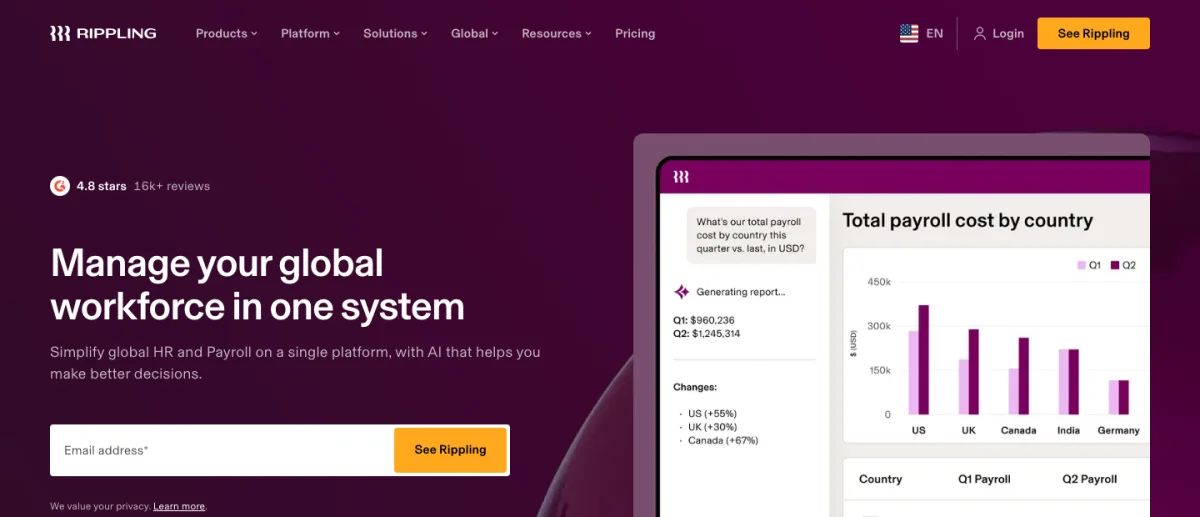
One record for everything a domestic employee touches. Hire someone in Rippling and the same entry provisions their laptop, their app accounts and their card, and removes all of it on their last day. For an IT-heavy company with a growing headcount at home, that is the actual product, and Deel's equivalents are younger.
Spend and finance on the same platform. Corporate cards, expense management and bill pay sit next to payroll, so card limits and approval rules can follow the org chart.
Automation across modules. Rippling's workflow builder and its integration library are aimed at companies that want rules to run across HR, IT and finance without a person in between.
Germany specifically. Rippling says its German payroll is certified for the statutory reporting system and books into DATEV — relevant if you run your own German entity and want global payroll there rather than an EOR.
Which one fits your hiring case
You work with freelancers in several countries
Deel. Contractor management is its origin, the payout options matter to the people you pay, and the price is published per contractor. Add Contractor of Record for the one or two roles that have grown into something close to a job.
You are hiring your first employee in a country where you have no company
Deel, unless that country is on Rippling's shorter list and you already run Rippling at home. The EOR is the product you are buying here, and reach plus a published price make the decision faster.
You are a US company of fifty or more, mostly domestic, with a few people abroad
Rippling. The value is the domestic platform — HR, payroll, devices, access, cards on one record — and the international employees ride along on the same system. Get the quote and check that your foreign countries are covered by its EOR.
You already have entities in several countries
Compare both on global payroll for your specific countries. This is the one case where the decision depends on the country list rather than the company: Deel covers more countries with its own engine, Rippling integrates payroll more tightly with the rest of the employee record.

Verdict
For hiring and paying people across borders, take Deel. It reaches more countries for employment, it pays contractors in the most ways, and it tells you the price up front. For a small or mid-sized company whose growth happens outside its home country, it is the better fit.
Take Rippling when the border is the side case. A domestic team that needs HR, IT and spend on one record, with a handful of people abroad, gets more from Rippling's platform than from Deel's international depth.
Whichever you choose, settle the legal setup before the vendor. Most bad experiences with either platform start with an EOR bought for a freelancer, or a freelancer contract used for what is really a job.
More on building a small-team HR stack: best HR software for small businesses.
Frequently Asked Questions
What is the main difference between Deel and Rippling?
Where each one starts. Deel began with paying contractors abroad and built employment, payroll and HR around that, so its strength is the number of countries where it can legally employ or pay someone for you. Rippling began as a US system of record for employees — HR, payroll, devices, apps, cards — and added global hiring on top. If borders are your problem, Deel is built around it. If running a domestic team on one system is your problem and a few people abroad are a side case, Rippling is.
Is an EOR the same as global payroll?
No, and confusing the two is the most expensive mistake in this category. With an Employer of Record, the provider is the legal employer in a country where you have no company: it signs the employment contract, runs payroll and carries the local employer duties. With global payroll, you already have your own legal entity in that country and are the employer yourself — the provider only calculates and pays salaries and files the taxes. EOR replaces founding a company; global payroll assumes you already did.
Do I need an EOR to work with a freelancer abroad?
Not if the person genuinely works as an independent contractor. Contractor management covers the contract, invoices and payments, and you remain responsible for classifying the relationship correctly. If the role looks more like employment — fixed hours, one client, your equipment, your instructions — the risk of misclassification grows. Both vendors sell a Contractor of Record option for that middle ground, in which they become the contracting party and take over the classification risk. When the relationship is employment in substance, an EOR is the clean answer.
How much do Deel and Rippling cost?
Deel publishes list prices per head and month: contractor management from $49, Contractor of Record from $325, global payroll from $29, EOR from $599. Rippling publishes only a platform entry point of $8 per employee per month plus a base fee and quotes everything else; its own comparison blog has cited EOR from $499, but that figure is not on its pricing page. Checked on 25 October 2026.
Which one covers more countries?
Deel, by a wide margin on employment. Deel lists full legal employment in 130+ countries and describes a network of its own entities; Rippling states EOR in around 80 countries through owned entities and partners. For paying contractors the gap is smaller — both reach far beyond 150 countries. Country lists change, so check the specific country you need on each vendor's site before you sign.
Can I switch an EOR employee to my own entity later?
Yes, with both. Once you open a company in that country, the employee can move from the EOR to your own entity and onto global payroll. Rippling stresses that this happens without re-onboarding because the record stays the same; Deel offers the same path inside one platform. Plan the switch around notice periods and local rules, because the employment relationship formally changes employer.
Is there a legal dispute between Deel and Rippling?
Yes. Rippling sued Deel in March 2025, alleging corporate espionage, and Deel filed counterclaims; the case was still unresolved in October 2026. It concerns the two companies, not the services they deliver to customers, so it does not change which product fits your hiring case. It is a reason to read each vendor's comparison page about the other as advertising rather than evidence.