Deel: Global Payroll & Contractor Management for Teams
Fastlancer Team · Updated: Oct 1, 2026

Short verdict
Ideal for
- Agencies & companies hiring contractors or employees abroad — without setting up local entities
- Freelancers & solopreneurs who want to bill international clients compliantly and get paid globally
- Growing teams that want contracts, compliance and payroll in one tool
Not ideal for
- Solo freelancers with no one employed abroad
- Anyone who only needs to receive money internationally
- Entry price
- From $49 / month
- Free to start?
- Free demo, no free plan — month-to-month, no long-term commitment
- Stands out for
- Contracts, compliance, payroll and global payments for 150+ countries in one platform — month-to-month.
You want to hire someone in another country. Do you really have to found a company there to do it?
Until recently you had two options, and both were bad. Set up a local entity — slow, expensive, and a lawyer in every market. Or improvise with a loose contract and a bank transfer, and hope nobody asks whether that person is really a freelancer. Most agencies and small companies can afford neither the entity nor the risk.
Deel sells the middle ground. It is a global HR and payroll platform that bundles contracts, compliance, payroll and payouts into one system, so the paperwork per country stops being your problem. This review walks through all five products, who each one is actually for, and where the friction sits that the pricing page does not mention. The short version: which one you need depends on a single question, and it is not about budget.
Jump to: Which problem are you solving? · Quick verdict · The five products · Four real situations · Hidden costs
Which problem are you solving?
Two questions decide which Deel product you need. Budget is not one of them — it follows from the answers.
1. Are these people freelancers, or employees? That is a legal status, not a preference. Someone who works set hours, uses your equipment and takes your instructions is an employee in most countries, whatever the contract says. Call it wrong and the bill arrives later as back taxes and social contributions.
2. Are they abroad, or in the US? Abroad pushes you to Contractor Management or EOR. US-only is the one case where the cheaper PEO route exists.
| Your situation | The product | Why that one |
|---|---|---|
| Freelancers abroad | Contractor Management | Compliant contracts, invoices and payouts in one place. This is where most teams start and stay. |
| Freelancers abroad, but the role looks like a job | Contractor of Record | Deel becomes the contracting party and carries the misclassification risk instead of you. |
| Employees abroad, no company there | Employer of Record | Deel is the legal employer in 130+ countries. Replaces founding a subsidiary. |
| Employees in the US only | US PEO | Payroll, benefits and HR compliance across all 50 states. |
| You are still looking for the people | Find Talent | Sourcing and applicant tracking. An add-on, not a starting point. |
Most teams land on Contractor Management and never move. The jump to EOR is not an upgrade — it is a different legal relationship, and you make it when you want an employee, not when you want more features.
Quick verdict
| Best for | Product | What you get | Watch out for |
|---|---|---|---|
| Working with freelancers abroad | Contractor Management | Local-compliant contracts, e-signature, invoices and payouts in 150+ countries and 90+ currencies, in one dashboard. | If all you do is send money, a payment tool does that for a fraction. You pay here for the contract and compliance layer. |
| Employing people abroad | Employer of Record | Deel employs the person locally and handles contract, payroll, taxes and statutory benefits. | Enterprise-level cost per head, and local notice periods apply — you cannot end it at a week's notice. |
| US payroll and benefits | US PEO | Payroll in all 50 states, health insurance, 401(k), workers' comp, HR compliance. | US-only. For a handful of employees, Gusto is usually the cheaper fit. |
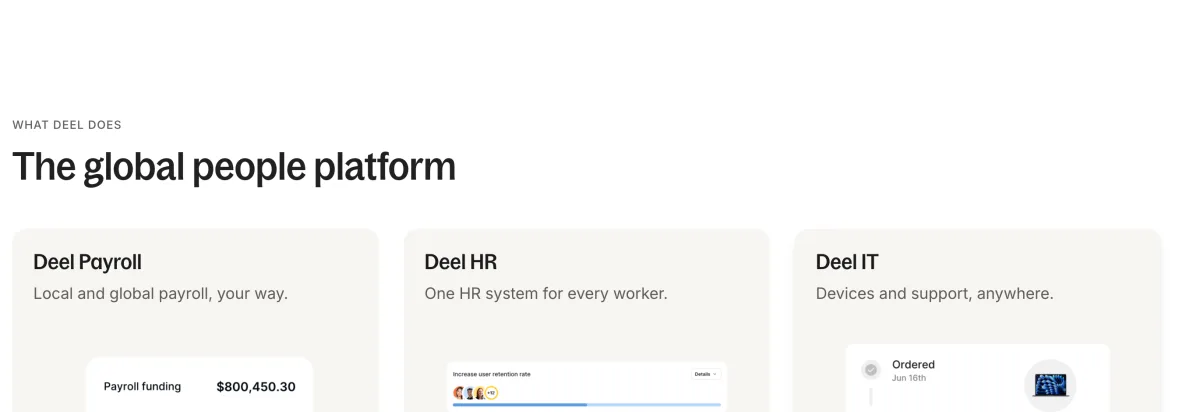
Deel is a global HR and payroll platform that solves one of the most tedious parts of cross-border work: bundling contracts, compliance, payroll and payments for people in different countries, compliantly, in one place. Instead of juggling separate contracts, tax setups and payment rails per country, everything runs through one system.
What is Deel?
Deel is built for companies and teams that work worldwide — and increasingly for freelancers who bill internationally. The platform covers several building blocks: Contractor Management (contracts, invoices and payouts to freelancers worldwide), Employer of Record (EOR — hiring employees in 130+ countries without your own entity), US PEO (payroll and benefits for US teams), Find Talent (recruiting/sourcing) and global payments.

The five products, and who each is for
Contractor Management
For: you already know who you want to work with, and they are freelancers abroad. You get: a contract that holds up in their country, auto-generated and e-signed, plus invoicing and payout in their currency. The trade-off: you are paying for the contract and compliance layer, not the transfer — Wise moves money for far less. Skip it if: you have one client relationship and a contract you already trust.
Contractor of Record
For: the uncomfortable middle — the person is formally a freelancer, but the role looks a lot like a job. You get: Deel steps in as the contracting party and carries the misclassification risk. The trade-off: several times the price of plain contractor management, for a risk that may never materialise. Skip it if: the engagement is genuinely project-based with the person setting their own hours. This product is new to most readers — and it is the honest answer when the cheap plan leaves the legal risk with you.
Employer of Record (EOR)
For: you want an employee in a country where you have no company. You get: Deel as the legal employer — employment contract, payroll, taxes, social contributions, statutory benefits. The trade-off: the highest cost per head by a wide margin, and you inherit local employment law. Skip it if: contractors would genuinely do. Worth knowing: this replaces founding a subsidiary, which is the comparison that makes the price look different.
US PEO
For: a US company with US employees. You get: payroll across all 50 states, health insurance, retirement plans, workers' comp and HR compliance in one dashboard. The trade-off: US-only, and the economics improve with headcount. Skip it if: you have a handful of people — Gusto or Rippling fit smaller teams better.
Find Talent
For: teams that actively recruit rather than hire people they already know. You get: sourcing and applicant tracking inside the same account. The trade-off: it is an add-on, and the per-head billing stacks on top of whatever else you run. Skip it if: your hiring is referral-driven. Most teams never switch it on.
Four real situations
The agency with freelancers in four countries
You run a digital agency. Three designers and a developer, in Brazil, India, the Philippines and Ukraine. Right now that is four contract templates you are not sure about, four payment methods, and a spreadsheet. Contractor Management collapses that into one dashboard with contracts that are pre-vetted per country. What it costs you is a per-head fee that a pure payment tool would not charge — what it buys is not having to answer "is this contract valid in Brazil?" yourself.
The startup that wants employees, not contractors
You are hiring in the UK, Germany and Singapore, and these are real jobs: fixed hours, your tools, your direction. Calling them freelancers is the expensive mistake. EOR lets you employ them properly without founding three companies. The number to compare against is not the contractor fee — it is what a subsidiary costs to set up and run in each of those countries, which is where the EOR price stops looking absurd.
The US company with thirty people
Everyone is in the US, and payroll plus benefits plus compliance is eating a day a week. US PEO handles all three. At thirty people the per-head pricing works in your favour; at five it does not, and Gusto is the better answer.
The solo freelancer with international clients
You bill clients in the US, the UK and Australia, and you want the money to arrive without losing a chunk to conversion. Deel is the wrong tool here — you are not hiring anyone. Wise or Payoneer receive international payments far more cheaply. The exception: your client already runs their contractors through Deel, in which case you join their account and it costs you nothing.
What the pricing page does not tell you
| Where it bites | What happens | What to do instead |
|---|---|---|
| Paying for a transfer | You are billed per contractor per month even in a month where you send one invoice. | If you have compliant contracts already, move the payouts to Wise and keep Deel only where the compliance matters. |
| No free plan | There is a demo, but nothing permanent — you cannot park an inactive contractor for free. | Billing is month-to-month. Switch people off in quiet months rather than carrying them. |
| Misclassification stays yours | On the standard contractor plan, Deel supplies the contract — the legal risk of calling an employee a freelancer still sits with you. | That is exactly what Contractor of Record exists for. Price the risk before you dismiss the upgrade. |
| Notice periods you did not sign | Under EOR, the country sets notice and severance. A month's notice is common, three is not rare. | Check the local rules before the hire, not at the end. Budget the exit with the entry. |
| Mandatory benefits | Statutory health, pension and leave contributions vary by country and sit on top of the per-head fee. | Use Deel's country calculator for total employer cost, not the headline figure. |
| Per-head fees stack | Every product bills per person, so two products on the same team bill twice. | Decide whether you really recruit, or only onboard people you already found. |
Who Deel is worth it for
Deel's value grows with every border. A solo freelancer receiving a single international payment a month is better off with a pure payment tool like Wise or Payoneer. But once you have several international clients or contractors, need compliant contracts, or want to actually employ someone abroad, Deel shows its strength: a contract, compliance and payout system instead of a patchwork of tools. For growing agencies and companies that do not want to build a legal entity in every country, the EOR building block is the real argument.
How much does Deel cost?
Deel bills per head, per month, with no minimum term. The range is enormous because these are five separate products, not five tiers of one: contractor management for people abroad, the contractor-of-record variant that moves the classification risk to Deel, recruiting, US employee administration, and full employment through Deel as the employer of record. The last costs many times the entry point — it also replaces setting up a local entity.
For freelancers and small teams, contractor management is the relevant entry. There is no permanent free plan, but a free demo and monthly cancellation.
What We Like About Deel and What We Don't
Pros
- Contracts, compliance, payroll, payments in one system
- Employer of Record in 130+ countries
- Month-to-month billing, no long-term commitment
- Freelancers can bill clients internationally, compliantly
Cons
- Per-head pricing pricier than simple payment tools
- EOR pricing hits enterprise budgets, not solo
- Broad platform, steep learning curve
If you are sorting out your international tool stack, our overview of finance tools for freelancers has fitting alternatives and add-ons — from pure payment tools to business bank accounts.
Pricing
Hire Contractors
$49
per contractor / month
- Contracts, compliance & invoices in 150+ countries
- Payouts in many currencies
- For working with freelancers
Hire (Talent/ATS)
$14
per worker / month
- Recruiting & talent sourcing (ATS)
- Candidate management
Contractor of Record
$325
per contractor / month — Deel takes on the misclassification risk
- Deel is the contracting party, not you
- For roles that sit close to the employee line
- Covers the classification risk the $49 plan leaves with you
Hire Full-time (US PEO)
$125
per employee / month
- Payroll & benefits for US teams
- HR compliance in the US
Hire Full-time (EOR)
$599
per employee / month
- Hire in 130+ countries without your own entity
- Payroll, benefits & local compliance
Prices may change — check the official website for current plans.
Price history
Checked Oct 23, 2026 · 4 plans unchanged since Aug 31, 2026
Alternatives by use case


Frequently Asked Questions
How much does Deel cost in 2026?
Deel bills per head, per month, and the range is wide because these are five separate products, not five tiers of one. What decides your cost is not a plan choice but a question of status: engaging a freelancer abroad is the cheapest entry, letting Deel carry the misclassification risk costs several times that, and having Deel legally employ someone is the most expensive by an order of magnitude — because it replaces founding a company in that country. There is no permanent free plan, and every product is month-to-month. The exact figures are in the pricing cards above.
Does Deel make sense for individual freelancers?
Yes, but with a different focus than for companies. As a freelancer you use Deel to bill international clients compliantly, keep contracts and invoices in one place, and get paid in many currencies. If all you need is to receive money, a pure payment tool like Wise or Payoneer is cheaper. Deel's value is bundling contract, compliance and payout in one system — especially when clients already run payments through Deel.
What is an Employer of Record (EOR) at Deel?
An Employer of Record legally employs someone on your behalf in a country where you have no company. Deel signs the employment contract, runs payroll, pays taxes and social contributions and provides the statutory benefits — you direct the work. That lets you hire in 130+ countries without founding a subsidiary. The trade-off is that you inherit local employment law with it: notice periods, severance rules and mandatory benefits are set by the country, not by your contract.
Deel vs. Remote vs. Wise — what is the difference?
Deel and Remote are both global HR platforms (contractor management + EOR + payroll); Deel is the broader platform with more countries and add-on products. Wise (formerly TransferWise) is not an HR platform — it is a low-cost multi-currency payment tool without contracts, compliance or employment. Rule of thumb: Wise for pure payments, Deel/Remote for hiring and compliantly engaging people across borders.
Can I cancel Deel monthly?
Yes. Deel explicitly advertises month-to-month billing with no long-term commitment — you pay per active contractor or employee per month and can end at month-end. US PEO occasionally runs promotions (e.g. 3 months free on 2-year contracts); outside such offers the model stays monthly and flexible. For EOR employees, local notice periods and severance rules still apply.
Verdict
Deel pays off the moment borders enter the picture: you engage freelancers or employees abroad, you do not want contracts, compliance and payout spread across five tools — and you do not want to set up a foreign entity. For pure payment receiving as a solo freelancer, a lean tool like Wise is cheaper; Deel's strength is the bundle of contract, compliance and global payment in one platform that scales with the team.