Fiverr Alternatives 2026: 6 Platforms With Lower Fees Compared
Fastlancer Team · Updated: Sep 12, 2026
Fiverr takes a flat 20% of every order, tips included, and that share does not shrink no matter how long you have worked with a client. But the question that brings most people here is not which platform is cheapest. It is where you actually go instead — because the cheapest platform is worthless if nobody there hires what you do.
So this page is sorted by your situation, not by commission rank — with the fee each platform charges you, the fee it charges your client, how you get work there, and who it lets in.
You already bring your own clients
Contra
Keeps 0% of what you bill
Free plan, or $29/month for Pro
On the free plan your client pays the platform fee instead. Pro removes it for them.
You want bigger, longer projects
Upwork
Hourly contracts and retainers are normal here
0% to 15% per contract
You see the exact fee before you send the proposal, and it is fixed for that contract.
You want the same marketplace, cheaper
Guru
Closest thing to a like-for-like swap
9% free, down to 5% on the top plan
The 5% tier costs $49.95/month, so it only pays above roughly $1,250 billed per month.
You have repeat clients in the UK or EU
PeoplePerHour
The fee falls the longer a client stays
20% to 7.5% to 3.5%, per client
The thresholds count lifetime billings with that one buyer, so the discount does not transfer.
You are a designer
99designs
Contests plus 1:1 design projects
15% at entry level, 5% at the top
Plus $100 per new client, and contest work that loses is unpaid work.
Toptal is the sixth platform on this page and deliberately has no card here. These cards answer “what fits my situation”; Toptal answers “can I pass the screening”, which is a different kind of question. Its profile is below.
How we ordered these six
Ranking freelance platforms by commission alone produces a list that reads well and helps nobody. Contra charges you nothing and is the worst choice on this page if you have no audience to bring. Toptal also pays out your full rate and rejects most applicants. A percentage on its own does not tell you whether you will earn anything there.
- What it costs you, and what it costs your client. Both sides matter. A platform that charges you 0% and your client $29 per payment has not made the money disappear.
- How you get work. Listing a service and waiting is a different job from pitching on posted briefs, and both differ from being matched by a recruiter or entering a contest.
- Who gets in at all. Two of these six screen applicants. On the others you can start this afternoon.
For comparison: Fiverr charges you a flat 20% on every order including tips, and it charges your buyer 5.5% plus $3 on orders under $100 on top of your price — covering add-ons, gig extras and tips as well, per Fiverr's own payment help page. So a $60 gig costs the client about $66 and pays you $48.
Compare the six
Contra
0% for you · $15 or $29 per payment for your client
Portfolio page and service listings. Open signup. Pro at $29/month waives the client fee.
Upwork
0–15% per contract · $0.99–$14.99 per contract for your client
You pitch on posted jobs using Connects. Longer engagements are the norm.
Guru
9% free · 7% / 6% / 5% on paid plans
Classic bid-on-jobs marketplace. Clients can agree to cover up to 5 points.
PeoplePerHour
20% → 7.5% → 3.5% by lifetime billings per client
Hourlies and proposals. Signup is reviewed. UK and EU client base.
99designs
15% / 10% / 5% by designer level, plus $100 per new client
Contests and 1:1 projects, design only. Losing a contest means unpaid work.
Toptal
You are paid your agreed rate; the client pays more
Matched engagements, no browsing. Under 3% accepted; screening runs 3 to 8 weeks.
| Platform | Your fee | Client pays | How you get work | Entry barrier | Model | Region focus | Best for |
|---|---|---|---|---|---|---|---|
 Fiverr (baseline) Fiverr (baseline) | 20% flat, tips included | 5.5% plus $3 under $100 | Buyers find your gig listing | Open signup | Gig marketplace | Global | Productized services, fast start |
 Contra Contra | 0% | $15 or $29 per payment over $500 | Portfolio page and service listings | Open signup | Portfolio and invoicing layer | Global, US-leaning | Keeping all of what you bill |
 Upwork Upwork | 0–15%, fixed per contract | $0.99–$14.99 per new contract | You pitch, using Connects | Open signup | Proposal marketplace | Global | Custom projects, long engagements |
 Guru Guru | 9%, or 7/6/5% on paid plans | Can agree to cover up to 5 points | You bid on posted jobs | Open signup | Classic marketplace | Global | A cheaper like-for-like swap |
 PeoplePerHour PeoplePerHour | 20% → 7.5% → 3.5% per client | Included in the commission | Hourlies and proposals | Signup is reviewed | Marketplace | UK and EU | Recurring UK/EU clients |
 99designs 99designs | 15/10/5% by level, plus $100 per client | Project or contest price | Contests and 1:1 briefs | Open signup | Design contests and projects | Global | Logo, brand and web designers |
 Toptal Toptal | You receive your agreed rate | More than you are paid | You are matched, you do not browse | Under 3% accepted, 3–8 weeks | Vetted network | US-leaning enterprise | Senior specialists |
Contra — 0% of what you bill
- Your fee
- 0%
- Client pays
- $15 or $29 per payment over $500
- How you get work
- Portfolio page with service listings
- Entry barrier
- Open signup
- Region
- Global, US-leaning
- Watch out for
- Contra Pro is $29/month and exists to remove the client fee
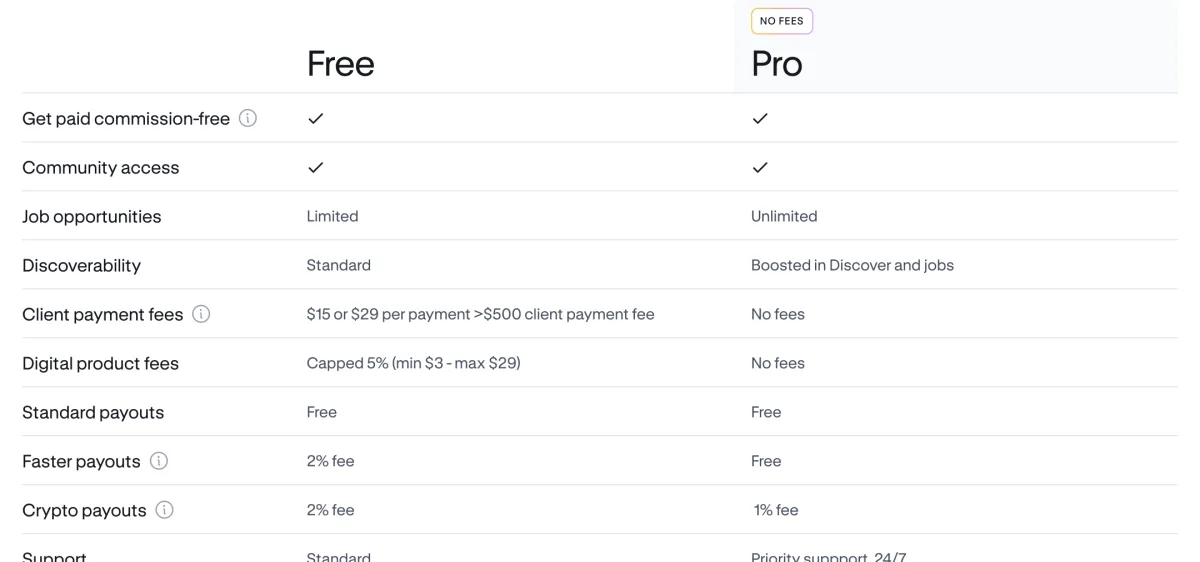
Contra inverts Fiverr's arrangement: it takes nothing from your invoice. Its own pricing page puts it plainly — commission-free for all creatives. The money comes from the other side, so read that side carefully before you quote. On the free plan your client pays a platform fee per payment, and digital products are charged at 5% with a $29 ceiling. Faster payouts cost you 2%.
That is what Contra Pro is for, at $29 a month or $199 a year: it waives those fees for your clients. Which reframes the comparison honestly. Moving $2,000 a month off Fiverr saves $400 in commission; on Contra you either hand your client a per-payment fee or absorb $29 yourself. You keep far more than Fiverr leaves you either way, but zero commission is not the same as zero cost.
The trade-off is discovery: Contra's marketplace is younger and smaller than Fiverr's, so it works best as the front end and payment layer for leads you already generate yourself.
Upwork — bigger contracts, fee fixed up front
- Your fee
- 0% to 15%, fixed once the contract starts
- Client pays
- $0.99 to $14.99 per new contract
- How you get work
- You pitch on posted jobs, spending Connects
- Entry barrier
- Open signup
- Region
- Global
- Watch out for
- Connects cost money and proposals often go nowhere
Upwork's own wording is the clearest fee statement on this page: the fee "ranges from 0% to 15% per contract", and "once your contract begins, the fee is fixed and won't change". A built-in calculator shows you the exact percentage and your net pay before you submit, which is a genuinely better deal than Fiverr's take-it-or-leave-it 20% — see the Freelancer Service Fee page.
You will read elsewhere that Upwork works out to roughly 10% in practice, including on this page until today. That figure comes from Upwork's own worked examples, where 10% illustrates how to price an hourly rate. It is a teaching aid, not a published average.
If you also hire, note the client side: a one-time Contract Initiation Fee of $0.99 to $14.99 applies to every new contract, rehires included.
The model is the bigger difference. You pitch rather than list, so time goes into proposals that do not convert — but projects skew larger and longer, with hourly contracts and retainers normal rather than exceptional. If Upwork is what you want to leave, we have a separate Upwork alternatives guide.
Guru — the cheapest like-for-like swap, if you bill enough
- Your fee
- 9% free; 7%, 6% or 5% on paid plans
- Client pays
- Can agree to cover up to 5 points of your fee
- How you get work
- You bid on posted jobs
- Entry barrier
- Open signup
- Region
- Global
- Watch out for
- The 5% rate needs the $49.95/month plan
Guru is the closest thing here to a straight swap: you bid on posted jobs, agree terms, invoice through the platform. Free accounts pay 9%, already less than half of Fiverr's cut. The lower rates are real but they are subscriptions — on Guru's own membership page, Basic+ at $11.95 still charges 9%, then $21.95 buys 7%, $33.95 buys 6% and $49.95 buys 5%, with up to 27% off annually.
So do the arithmetic before subscribing. Going from 9% to 5% saves four points, and four points has to beat $49.95 a month — which happens at roughly $1,250 billed per month through Guru. Below that the membership costs more than it returns, and the free plan at 9% is the better deal.
One mechanic exists nowhere else here: your client can agree to cover part of the fee. Guru's own examples put a Basic freelancer at 9% with the employer taking 2.5 points, for an effective 6.5% — and an Executive member at 5% with all five covered, for nothing. It is negotiable, so raise it when you agree terms.
PeoplePerHour — the fee falls as the client stays
- Your fee
- 20%, then 7.5%, then 3.5% by lifetime billings
- Client pays
- Included in the commission
- How you get work
- Hourlies and proposals on posted briefs
- Entry barrier
- Signup is reviewed
- Region
- UK and EU
- Watch out for
- Thresholds count per client, so the discount does not transfer
This is the one structural answer to Fiverr's flat rate. PeoplePerHour's commission is tiered by how much you have billed a single buyer over the lifetime of that relationship: 20% below £250 (quoted as $350 or €300), 7.5% from there up to £5,000, and 3.5% above it. All three are exclusive of VAT.
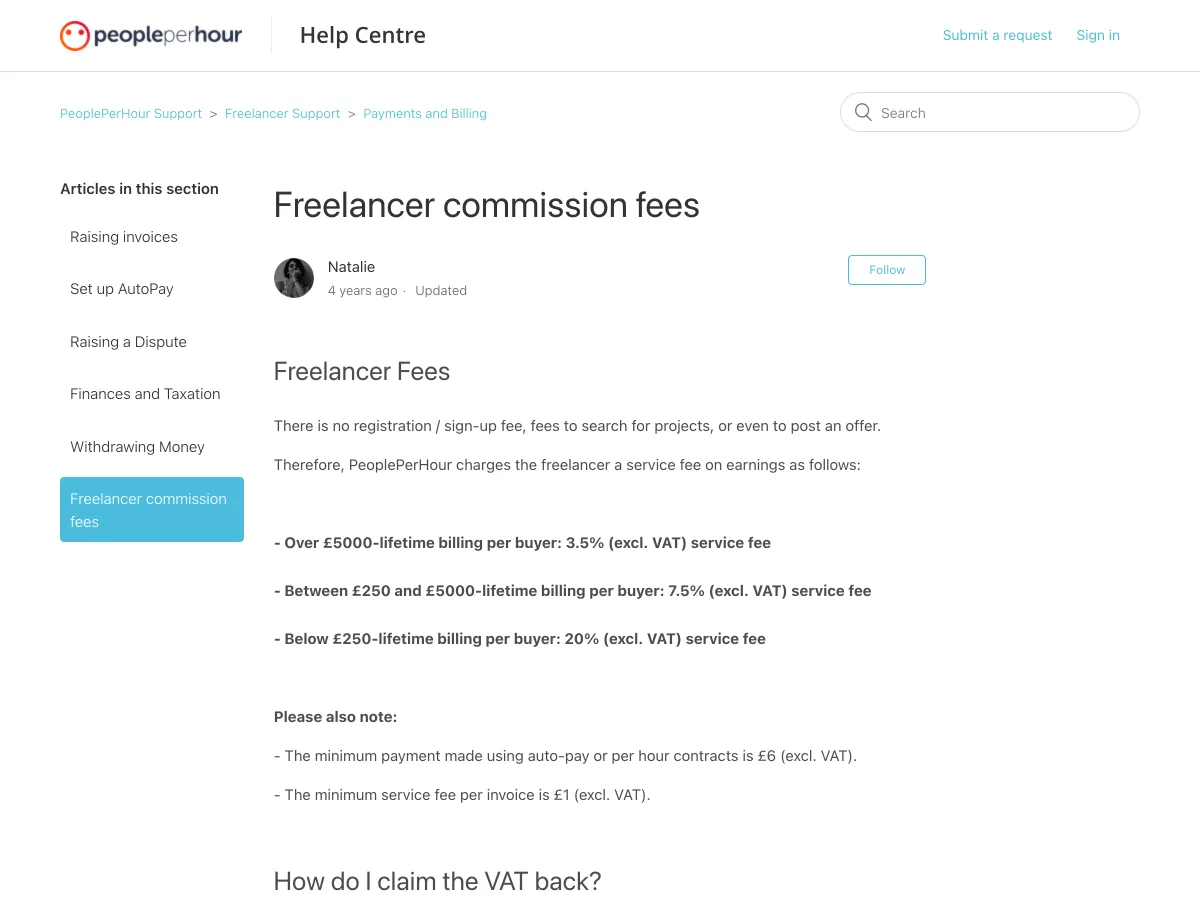
The rates are marginal, not flat, and that matters on your first invoice. PeoplePerHour's own worked example charges a £500 website 20% on the first £250 and 7.5% on the rest, for £68.75 in total — an effective 13.75%, already below Fiverr on job one. Every further pound from that buyer is charged at 7.5%. Two minimums sit underneath: £6 excluding VAT for any auto-pay or hourly payment, and £1 excluding VAT in service fee per invoice, so very small jobs are not worth raising here.
The consequence is the opposite of Fiverr's: the longer a client stays, the less the platform takes. A client you have billed £10,000 costs you 3.5%, where the same client on Fiverr would still be costing 20% — that is the argument for this platform, and it is the only one on this page where loyalty is priced in.
Two caveats: the tiers reset for each new buyer, so a business of many small one-off jobs never leaves the 20% band — and the client base skews to the UK and Europe, which the three-currency thresholds quietly confirm.
99designs — design only, and the entry level is the expensive one
- Your fee
- 15% entry, 10% mid, 5% top level
- Client pays
- The project or contest price
- How you get work
- Contests and 1:1 briefs
- Entry barrier
- Open signup, design work only
- Region
- Global
- Watch out for
- $100 per new client, and losing a contest pays nothing
99designs is the design specialist: clients either launch a contest, where several designers submit and the winner is paid, or hire one designer directly. The fee structure is published on its designer page and falls with your level — 15% at entry, 10% at mid, 5% at top. On top of that sits a $100 introduction fee for each new client, spread across that client's first $500 of charges.
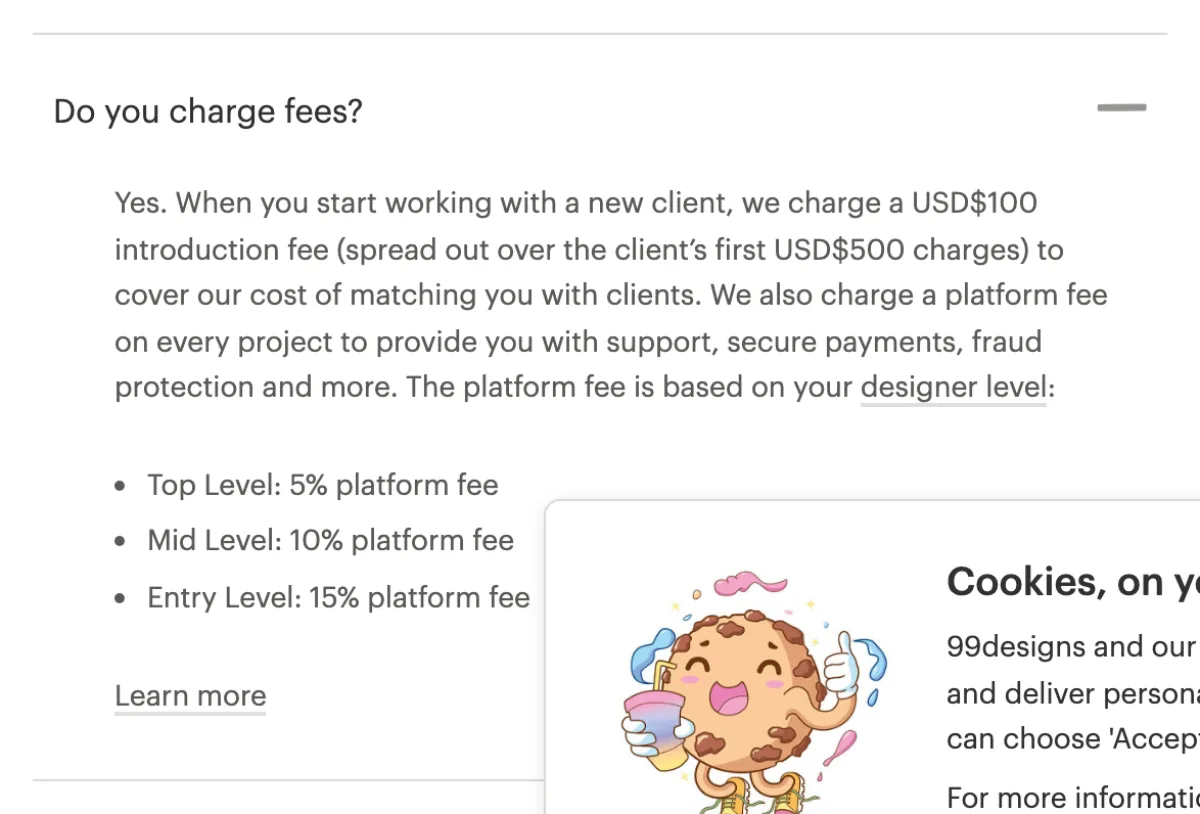
Read that against who is usually advised to go there. A beginner sits at entry level and pays 15% plus $100 per new client — the highest total cost on the platform — while a top-level designer pays 5%. The ladder rewards the people who need it least. And contests carry the risk the model is built on: you can do the work and be paid nothing. If design is your field, 99designs is still worth a look before any general marketplace, but go in knowing which rung you are on. Dribbble and Behance job boards are a lower-risk supplement, both covered in our freelance platform comparison.
Toptal — full rate, if you get through
- Your fee
- You receive your agreed rate
- Client pays
- More than you are paid
- How you get work
- You are matched; there is nothing to browse
- Entry barrier
- Fewer than 3% accepted; 3 to 8 weeks
- Region
- US-leaning, larger companies
- Watch out for
- The screening is the product, and most people do not pass
Toptal is not an open marketplace and not invite-only either — you apply, and most applications are declined. Its own screening page states that of the thousands of monthly applications, "typically fewer than 3% are accepted". The process runs 3 to 8 weeks and includes a language check, a live skills assessment and a test project of one to three weeks.
Clear it and you are matched with engagements rather than bidding for them, paid the rate you agreed. Toptal does not publish how it prices that work to clients, so treat any precise claim about its margin as unverified. It is a different product from the other five, not a better one: it suits senior specialists with a verifiable track record, and nobody who needs work this month. We compare it with other vetted networks in the Toptal alternatives guide.
When switching is not worth it
Fee arithmetic is the easy part of this decision. Three situations where leaving Fiverr costs more than it saves.
Your reviews and level are the asset. Ratings, order history and seller level do not travel. Arriving on a new platform means starting at zero visibility while the one you left keeps sending work — and on most of these six, zero visibility is a slow, quiet place. The 20% is the price of an audience you already have.
Your work is productized and small. Fixed-scope, low-ticket, repeatable orders are what gig listings are built for. On a proposal marketplace, each one needs a pitch, so the effective cost per order outruns any fee difference — and PeoplePerHour's tiers leave you in the 20% band permanently if each client buys once.
You have no lead flow of your own. This is the one that catches people, because the platform with the lowest fee is the one that demands it most. Contra takes 0% and expects you to arrive with an audience. Without one, 0% of nothing beats 80% of something in no arithmetic at all.
Running two platforms in parallel
A sensible approach is not to depend on a single channel for client acquisition — and none of these six requires exclusivity, so running two costs nothing beyond the time to maintain a second profile.
The pairing that makes structural sense is one platform for reach and one for margin: Fiverr or Upwork keeps inbound work arriving while you are unknown elsewhere, and Contra or direct invoicing handles the clients you brought yourself, at a fee you control. Over time the second channel grows and the first becomes optional rather than load-bearing — a better position than a sudden switch.
Two practical notes. Keep pricing consistent across profiles, because clients do compare and Fiverr's buyer fee means your listed price there is not what they pay. And wind an account down rather than deleting it: an idle profile with good reviews stays an asset, and closing it throws away the one thing that does not transfer.
If you want the wider field rather than the six here, our comparison of 25+ freelance platforms covers the niche and regional options this page leaves out.
Frequently Asked Questions
What is the best Fiverr alternative with lower fees?
Contra takes 0% of what you bill — your client pays a platform fee of $15 or $29 per payment instead, or you pay $29/month for Contra Pro to waive it for them. Guru charges 9% on its free plan and 5% on the $49.95/month Executive plan, so the top tier only pays off above roughly $1,250 billed per month. PeoplePerHour drops from 20% to 7.5% and then 3.5% as your lifetime billings with one buyer grow. All three beat Fiverr's flat 20%, which never decreases.
Is Upwork better than Fiverr?
Different model, usually better economics. Upwork's service fee ranges from 0% to 15% per contract, you see the exact percentage and your net pay before submitting a proposal, and it is fixed once the contract begins. Fiverr charges a flat 20% on everything including tips. You will often read that Upwork works out to about 10% in practice — that figure comes from Upwork's own worked examples and is a teaching aid, not a published average. The bigger difference is that Upwork is proposal-based: you pitch on posted jobs using Connects instead of waiting for gig orders.
Which Fiverr alternative has no commission at all?
Contra — freelancers keep 100% of what they bill, and the platform earns from client-side per-payment fees and Pro memberships. Toptal also pays out your full agreed rate, but it is a screened network rather than an open marketplace: Toptal states that fewer than 3% of applicants are accepted, and the process takes three to eight weeks including a test project. It is not invite-only — you apply — but it is not a Fiverr-style platform you can start on this week either.
What is the best Fiverr alternative for designers?
99designs by Vista — design contests plus 1:1 projects, purpose-built for logo, brand and web design. Read the fee ladder before you commit: the platform fee is 15% at entry level, 10% at mid and 5% at top level, plus a $100 introduction fee per new client spread over that client's first $500. So beginners pay the most, and contest entries that lose are unpaid work. Dribbble and Behance job boards are a lower-risk supplement — both are covered in our freelance-platform comparison.
Should I leave Fiverr completely?
Usually not immediately. Ratings, order history and seller level do not transfer, so arriving elsewhere means starting at zero visibility while Fiverr keeps sending work. A sensible approach is to run platforms in parallel: keep existing gigs, move new client acquisition to a lower-fee channel, and wind the account down rather than deleting it once the second channel carries itself. An idle profile with good reviews stays an asset.
Which Fiverr alternative is best for hiring freelancers?
Upwork for most briefs — the largest pool for custom project work, though you pay a one-time Contract Initiation Fee of $0.99 to $14.99 per new contract, including rehires. Toptal when the risk of a bad hire outweighs the cost, since the screening is the product. Contra if you would rather pay a per-payment platform fee than a markup. For comparison, hiring on Fiverr adds a buyer service fee of 5.5% plus $3 on orders under $100 to the price you see.
How long until the first order on a new platform?
There is no reliable published figure, and anyone quoting one is guessing. What does differ is the mechanism. On Contra nothing arrives until you send clients there yourself, because it is a portfolio and payment layer more than a marketplace. On Upwork, Guru and PeoplePerHour you are pitching from day one, so the pace depends on how many proposals you send. On 99designs you can enter a contest immediately — and be paid nothing if you do not win. Toptal is the outlier: the screening alone runs three to eight weeks before any client contact.