EU AI Act for Freelancers and Small Teams: AI Literacy, Labelling Rules and a One-Page AI Policy (2026)
Fastlancer Team · Updated: Sep 8, 2026

Since 2 August 2026 most of the EU AI Act applies and national authorities can enforce it. If you use ChatGPT, Claude, Midjourney or a meeting transcriber in your work, two duties matter: AI literacy and labelling. Both take half an hour, no law firm and no training vendor required.
Does the AI Act apply to me?
- You use AI tools in your work and you are based in the EU: yes, as a deployer, whatever your size.
- You are outside the EU but your AI-assisted output is used in the EU, for example for EU clients: yes, the deployer duties reach that work (Art. 2).
- You build AI applications for clients, such as a chatbot that goes live under your name: yes, possibly as a provider with further duties.
- You use AI purely for personal, non-professional purposes: no.
Deployer or provider: your role decides
The Act separates providers, who develop an AI system and place it on the market under their own name, from deployers, who use a system professionally. OpenAI is the provider of ChatGPT, you are the deployer. Almost every freelancer and small team sits in the second group, and the two duties below are the whole list for them.
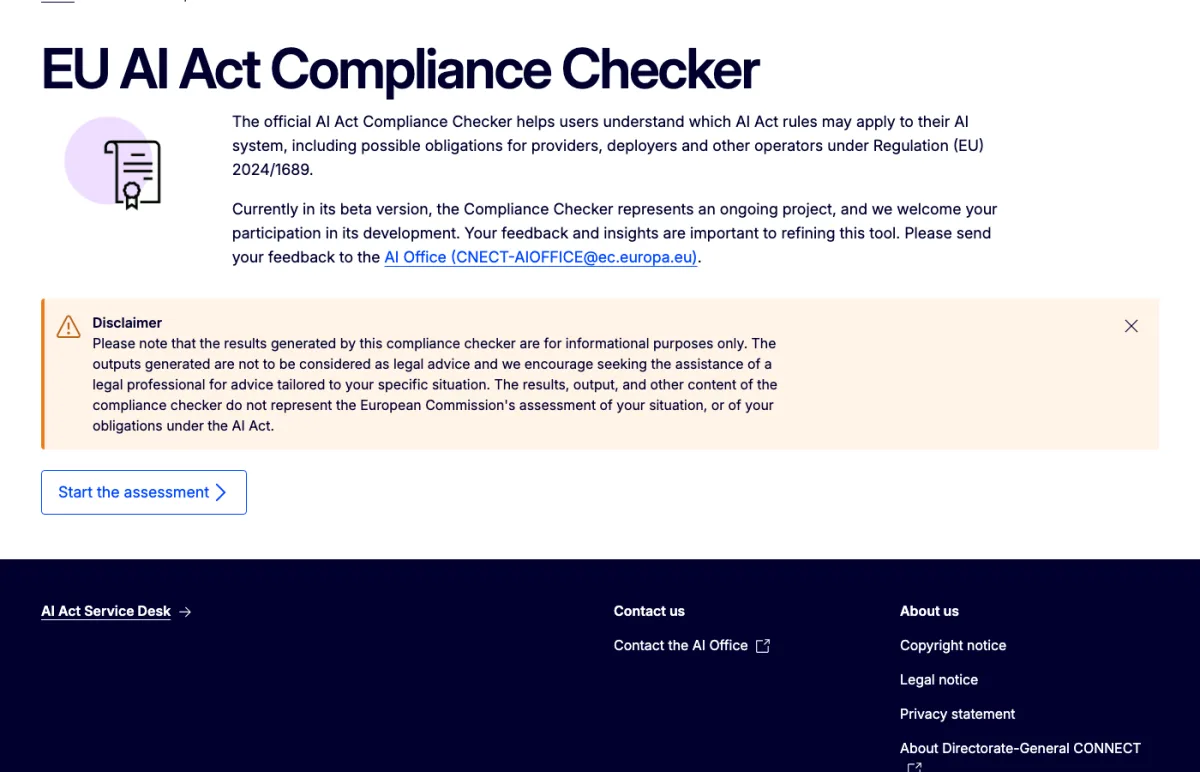
It changes when you build AI applications for clients that go live under your name, say a support chatbot on a client's website. Then you may be a provider. For that case the European Commission runs the official Compliance Checker: it asks about your role and your system and lists the obligations that may apply. It is still in beta, and it is the one source with nothing to sell.
AI literacy under Article 4 (duty 1)
Since 2 February 2025 providers and deployers must take measures so that the people using AI on their behalf understand the tool: what it can do, where it hallucinates, which data belongs in it and which does not. The duty applies regardless of company size. As a solo freelancer, you are the staff in question.
The Commission is explicit: there is no mandatory training and no certificate. The Digital Omnibus even removed the phrase about a "sufficient level" in summer 2026; what is required are measures that fit prior knowledge, context and risk. An internal record of what you covered and when is recommended. For a small team that means a 30-minute briefing on hallucinations, data protection and labelling, noted with a date. National authorities can check this since August 2026.
Labelling AI content under Article 50 (duty 2)
The transparency duties apply since 2 August 2026 and were not postponed by the Digital Omnibus. Three cases matter for deployers:
| Content | Your duty | Exception |
|---|---|---|
| Deepfakes: AI images, video or audio showing real people, places or events in a deceptively realistic way | Disclose clearly as AI-generated at first exposure | Evidently artistic or satirical works: a discreet notice is enough |
| AI text on matters of public interest (politics, justice, health, environment) that you publish | Label as AI-generated | Text reviewed by a person or under editorial responsibility: no label required |
| Chatbot on your website | Telling users they are talking to an AI is the tool provider's duty; you check that the notice shows | When it is obvious to users that an AI is answering |
The key exception sits in the second row: whoever reviews AI drafts before publishing and takes responsibility does not have to label anything. That is how we handle it at Fastlancer, as stated on our About page. Proposals, product copy and posts on your own field are not "public interest" in the first place. Content published before 2 August 2026 does not need retroactive labels.
Fines for breaching the labelling duties reach 15 million euros or 3 percent of annual turnover, and the Act explicitly requires proportionality for small businesses. For a solo business the realistic first step is a request to fix things, not a penalty notice.
High-risk AI: from December 2027, and rarely your concern
The Digital Omnibus postponed the strict rules for high-risk systems: Annex III (including AI in recruiting, credit scoring and education) applies from 2 December 2027, Annex I from 2 August 2028. For a solo business this only becomes relevant if you use AI to screen applicants or to score people. Courses selling you high-risk documentation today can be skipped.
A one-page AI policy for solo businesses and teams up to 20
Law firms deliver ten-page AI policies for corporations. A small team needs one page, and it doubles as your Article 4 record. Copy, fill in, file:
AI policy [company], as of [date]
- Purpose: We use AI for drafts, research, translation and transcription. The person using a result is responsible for it.
- Approved tools: [ChatGPT Team, Claude, DeepL, Fireflies]. New tools only after checking data protection and data location.
- Off-limits data: Client data, health and financial data, credentials and contract content go only into tools with a data processing agreement and EU hosting, never into free consumer versions.
- Review rule: No AI text and no AI image leaves without a content review by a person. Numbers, quotes and legal statements are checked against the source.
- Labelling: Deepfakes are always labelled as AI-generated. Published texts on matters of public interest are reviewed or labelled.
- Owner: [name]. Questions and edge cases go to this person.
- AI literacy: Briefing on hallucinations, data protection and labelling on [date] for [names]; refresher yearly and with every new tool.
Which duties your tools already cover
The machine-readable watermark in AI images, audio and video is a provider duty: OpenAI and Adobe attach provenance data under the C2PA standard, Google uses SynthID. Systems already on the market before 2 August 2026 have until 2 December 2026. The visible deepfake notice stays your job, because nobody sees metadata while scrolling.
Chatbot builders must ship the AI notice inside the product. Check it in the test widget before you install a tool for a client. The AI writing and transcription tools we recommend for small teams are in the Text and AI category; for meeting transcription, see Fireflies.
Official sources instead of law-firm newsletters
- Compliance Checker by the European Commission: role and obligations in a few questions, beta.
- AI Act Explorer: the full text by article and annex, with recitals.
- AI Act Service Desk: submit questions to the Commission, free of charge; its National Resources section lists the authority for each member state.
- Commission FAQ on Article 50 and on Article 4: the sources for every statement in this guide.

For more help choosing your toolkit, see the overview of the best tools for freelancers.
Frequently Asked Questions
Does the EU AI Act apply to a US or UK freelancer?
It can. The Act covers deployers outside the EU when the output of the AI system is used in the EU (Art. 2). If you deliver AI-assisted work to EU clients, the deployer duties apply to that work. Purely domestic US or UK business is out of scope, though clients may still ask for the same standards by contract.
Do I have to take an AI training course as a solo freelancer?
No. Article 4 requires measures for AI literacy, and the Commission is explicit: no mandatory training, no certificate. For a solo business it is enough to understand your tools and keep a short dated note. National authorities can check this since August 2026.
Do I have to label text I wrote with ChatGPT?
Only if the text covers a matter of public interest (politics, justice, health, environment) and is published without human review. Once you review the content and take responsibility, the labelling duty falls away. Proposals, product copy and posts on your own field are not covered in the first place.
Do I have to label AI images on Instagram or LinkedIn?
Under the AI Act only deepfakes: images, video or audio that show real people, places or events in a deceptively realistic way. A clearly illustrative AI graphic with no real-world reference triggers no duty. The platforms may require their own AI labels, which is a separate layer.
What are the fines?
Breaches of the labelling duties carry fines of up to 15 million euros or 3 percent of worldwide annual turnover, with proportionality for small businesses written into the Act. Enforcement sits with national market surveillance authorities, in Germany the Bundesnetzagentur since July 2026.