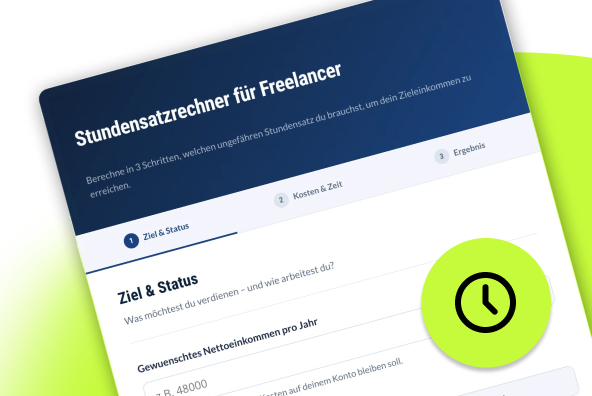
Employee vs. Freelancer Calculator
Employee vs. Freelancer Calculator
Enter your employed salary and your freelance rate — and see what you actually take home in both scenarios.
Want to know exactly what rate to charge — factoring in your costs, market positioning, and income goal?
📳 Calculate your minimum hourly rateEmployment net: Gross salary minus income tax (flat effective rate) minus employee social contributions (flat rate). Monthly figure = annual / 12.
Freelance gross revenue: Hourly rate × (working weeks/year × hours/week × utilisation %) / 12 months. This is the monthly revenue before any deductions.
Freelance net: Revenue minus business costs minus health insurance minus income tax (flat effective rate on profit).
Break-even rate: The hourly rate at which freelance net equals employment net, recalculated at 50%, 70%, and 90% utilisation.
Important simplifications
Both income tax rates are applied as flat effective rates — actual tax is progressive and depends on deductions, filing status, and local rules. The calculator does not account for employer-side contributions (which are a cost to the employer but don't affect employee net pay directly), self-employment taxes (e.g. US SE tax, UK Class 4 NI), retirement contributions, or tax-deductible business expenses reducing taxable income. Results are estimates for planning purposes.
Privacy
All inputs are processed locally in your browser. No data is transmitted or stored.
Disclaimer
Results are estimates for comparison and planning purposes only. They do not constitute financial, tax, or legal advice. Consult a qualified professional for binding guidance.
This tool was developed by Fastlancer. Reproduction or embedding requires visible attribution linking to fastlancer.org. © Fastlancer 2026
Employment or self-employment?
Everyone considering the move to freelancing asks the same question: what will I actually have left at the end of the month — and is it really worth it?
The answer is more complicated than it looks. A gross salary and a gross hourly rate can't be compared directly — the math behind them is too different. As an employee, your net pay arrives automatically, fully processed. As a freelancer, you receive everything first — and it's entirely your responsibility to figure out how much of it you actually keep.
The calculator below makes the comparison concrete: enter your employed salary and your freelance rate, and see what remains in both scenarios after tax, insurance, and costs.
What the comparison reveals
Many aspiring freelancers compare their gross hourly rate with their gross salary — and get completely the wrong answer. The right comparison is a different one: what do you actually have left at the end of the month?
As an employee, your employer quietly pays around 10–20% of your gross salary on top in employer-side contributions — money spent on your behalf that never touches your account. As a freelancer, you bear those costs yourself: the full health insurance premium with no employer subsidy, no sick pay, no paid leave.
Then there's a factor many underestimate: utilisation. An employee gets paid regardless of productivity. A freelancer only earns when they deliver billable work. In the first year, most freelancers realistically work at 50–70% utilisation — which pushes the break-even rate considerably higher than most expect.
That doesn't mean freelancing isn't worth it — for many people, it absolutely is. It just means going in with open eyes: with a financial buffer for the ramp-up period, a realistic rate, and a clear picture of what you actually need to earn.
Also frequently used